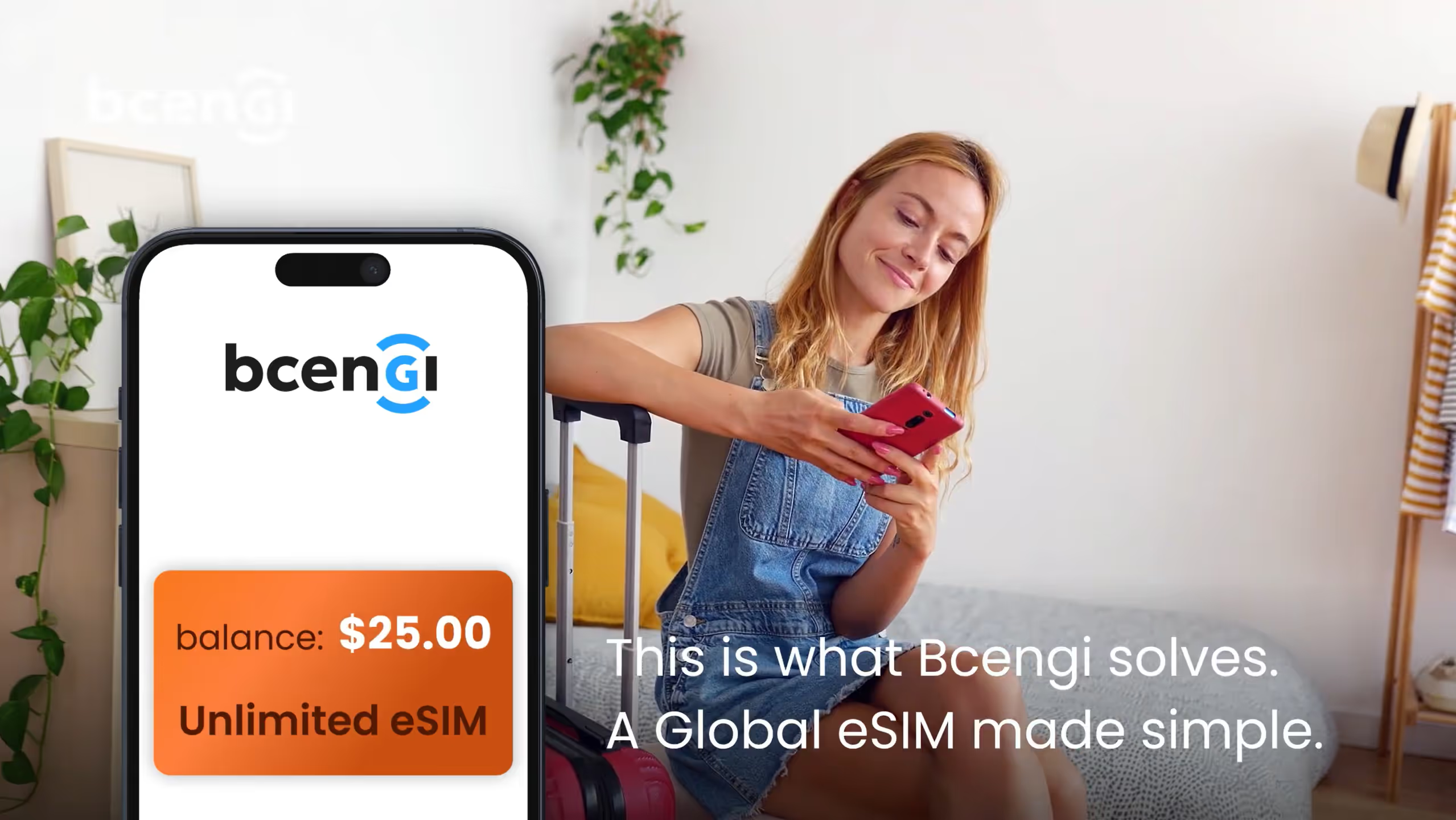

Personal Travel
Personal Travel



Benin

Celtiis
Pay As You Go
from
$
8.72
/GB
$10
POPULAR
$25
$50
$100
Select your starting balance
Get your eSIM
→

Your payment is fully secured |
Powered by

Rated
4.7


Install once, keep it on your phone.

Pay as you go, for actual use.

No fixed plans, no expiration.

Use balance only when you travel.

One eSIM for all trips, 200+ Countries.
Pay As You Go data, wherever you travel
💵 You add
$25
to your balance.
✈️ In
Benin
you use
3GB
at
$
8.72
/GB
.
🌍
France
3 months later -
3GB at $
1.19
/GB.
🔥 Your same balance covers both trips -
one eSIM, no expiry, no wasted data, no new package.
Just $
8.72
per GB. No surprises, No bundles, No expiry.

Light Usage
~200 MB/day
$
0.00
/day
Maps, messaging, browsing

Moderate
~500 MB/day
$
0.00
/day

Heavy
~2 GB/day
$
0.00
/day
Streaming, uploads, video calls
Cotonou: As Benin's economic hub, Cotonou offers the country's most reliable 4G coverage, especially in central business districts like Ganhi and around the international airport. Connections are generally strong in tourist areas like the Dantokpa Market, though network congestion can occur during peak hours. Indoor signal in larger concrete hotels and office buildings can be weaker, often improving near windows.
Porto-Novo: The capital city has good 4G connectivity, particularly in the administrative center and main commercial areas. The network is generally stable for navigating the city and visiting key sites. In some of the older colonial-era buildings with thick walls, you might experience a drop in signal strength when indoors.
Ouidah: This historic city has dependable coverage in its central areas, including along the main road and around the Python Temple. As you follow the Slave Route towards the Door of No Return on the coast, the signal may become less consistent. Connectivity is generally better outdoors than inside older, traditional buildings.
Parakou: In northern Benin's largest city, you can expect solid 4G performance in the bustling city center and around the Grand Marché. The signal is reliable for day-to-day use within the main urbanized area. As you travel to the city's outskirts, the connection may transition to a slower but still functional 3G network.
Ganvié: Connectivity in the unique stilt village of Ganvié is dependent on shoreline cell towers. You'll find a usable but variable signal across the water, which can be affected by weather and your specific location on Lake Nokoué. The connection is generally sufficient for messaging and light browsing, but can be less stable than on the mainland.

Major National Highways (RNIE): Coverage is generally reliable along the coastal RNIE 1 highway connecting Cotonou, Ouidah, and the border with Togo. On the main north-south artery, the RNIE 2, expect a strong signal in and around major cities like Cotonou and Parakou, but be prepared for service to weaken or drop in the long rural stretches between these urban centers.
Cotonou-Parakou Railway: For travellers on the primary rail line, mobile connectivity is inconsistent. Signal is typically available when passing through towns and populated areas along the route, but service can be patchy or completely unavailable in the remote agricultural regions the railway crosses.
Atakora Mountains: In northwestern Benin, the rugged terrain of the Atakora mountain range significantly impacts mobile coverage. While you can find a signal in towns like Natitingou, expect frequent and prolonged signal loss when travelling on the smaller roads that wind through the hills and valleys of this region.
National Parks and Borderlands: Remote areas have extremely limited to no mobile network coverage. This is especially true for Pendjari National Park and W National Park in the far north, as well as sparsely populated zones along the borders with Burkina Faso and Niger, where reliable service is rare outside of border towns.
Lake Nokoué and River Valleys: Connectivity on Lake Nokoué, including around the stilt village of Ganvié, can be variable. The unique over-water geography can lead to weaker signals compared to nearby land areas. Similar patchiness is common when travelling along the Ouémé and Niger river valleys away from settlements.
How it works
Buy eSIM
Sign up and get your Global eSIM in just a few clicks.

Activate eSIM
Scan the QR code and get connected instantly — no physical SIM needed.

Pay as you go
Only pay for what you use. No contracts, no hidden fees.

Get your eSIM
“
I loved the per-country pricing model. I only paid for the countries I visited, and it was way cheaper than other eSIM providers. No hidden fees — just clear and simple.
“
The auto top-up feature is a lifesaver. I never have to check my balance — internet just works. And when I’m not traveling, I don’t pay. It’s fair and super convenient.


Angel Siphron
Rated
4.7


Data from Bcengi costs $8.72 per gigabyte when operating on Celtiis networks. You are billed solely for your actual data consumption, without any required bundles or minimum spending commitments.
No, it is not. Bcengi functions concurrently with your current SIM card through dual-SIM capabilities. You can continue utilizing your standard SIM for voice calls and messaging.
Yes, provided your specific device offers eSIM support, which is common in most smartphones manufactured since 2019. You can verify your device's compatibility at bcengi.com/travelpass/esim-compatibility.
The extent of coverage is determined by the infrastructure of the Celtiis network. Generally, robust signal strength is found in prominent cities and popular tourist destinations. Conversely, areas that are more remote might experience restricted signal availability.
Most visitors consume between 500 MB and 2 GB of data daily. For a standard week of usage, the cost comes to roughly $30.52 when using pay-as-you-go rates.
Absolutely. A single Bcengi eSIM provides service across more than 200 countries. Your existing balance is transferable, eliminating the need to acquire a separate eSIM for every new place you visit.
You have the option to add funds at any moment by visiting travel.bcengi.com, or you can activate an auto-refill feature to ensure your balance remains continuously available.
No, it will not. Your Bcengi balance maintains its validity indefinitely, regardless of whether you utilize it in the near future or much later.

$
8.72
/GB

Instant delivery

No expiry

24/7 support

Secure checkout

Pay As You Go
from
$
8.72
/GB
$10
POPULAR
$25
$50
$100
Select your starting balance
Get your eSIM
→

Secure Payments |
Powered by

Rated
4.7


💵 You add
$25
to your balance.
✈️ In
Benin
you use
3GB
at
$
8.72
/GB
.
🌍
France
3 months later -
3GB at $
1.19
/GB.
🔥 Your same balance covers both trips — one eSIM, no expiry, no wasted data, no new package.
How it works


Install once, keep it on your phone

Use balance only when you travel

Pay as you go, for actual use.

No fixed plans, no expiration

One eSIM for all trips, 200+ Countries.
Learn more
Just $
8.72
per GB.
No surprises, No bundles, No expiry.

Light Usage •
200 MB/day
$
0.00
/day
Maps, messaging, browsing

Moderate •
500 MB/day
$
0.00
/day

Heavy •
2 GB/day
$
0.00
/day
Streaming, uploads, video calls
Cotonou: As Benin's economic hub, Cotonou offers the country's most reliable 4G coverage, especially in central business districts like Ganhi and around the international airport. Connections are generally strong in tourist areas like the Dantokpa Market, though network congestion can occur during peak hours. Indoor signal in larger concrete hotels and office buildings can be weaker, often improving near windows.
Porto-Novo: The capital city has good 4G connectivity, particularly in the administrative center and main commercial areas. The network is generally stable for navigating the city and visiting key sites. In some of the older colonial-era buildings with thick walls, you might experience a drop in signal strength when indoors.
Ouidah: This historic city has dependable coverage in its central areas, including along the main road and around the Python Temple. As you follow the Slave Route towards the Door of No Return on the coast, the signal may become less consistent. Connectivity is generally better outdoors than inside older, traditional buildings.
Parakou: In northern Benin's largest city, you can expect solid 4G performance in the bustling city center and around the Grand Marché. The signal is reliable for day-to-day use within the main urbanized area. As you travel to the city's outskirts, the connection may transition to a slower but still functional 3G network.
Ganvié: Connectivity in the unique stilt village of Ganvié is dependent on shoreline cell towers. You'll find a usable but variable signal across the water, which can be affected by weather and your specific location on Lake Nokoué. The connection is generally sufficient for messaging and light browsing, but can be less stable than on the mainland.
Major National Highways (RNIE): Coverage is generally reliable along the coastal RNIE 1 highway connecting Cotonou, Ouidah, and the border with Togo. On the main north-south artery, the RNIE 2, expect a strong signal in and around major cities like Cotonou and Parakou, but be prepared for service to weaken or drop in the long rural stretches between these urban centers.
Cotonou-Parakou Railway: For travellers on the primary rail line, mobile connectivity is inconsistent. Signal is typically available when passing through towns and populated areas along the route, but service can be patchy or completely unavailable in the remote agricultural regions the railway crosses.
Atakora Mountains: In northwestern Benin, the rugged terrain of the Atakora mountain range significantly impacts mobile coverage. While you can find a signal in towns like Natitingou, expect frequent and prolonged signal loss when travelling on the smaller roads that wind through the hills and valleys of this region.
National Parks and Borderlands: Remote areas have extremely limited to no mobile network coverage. This is especially true for Pendjari National Park and W National Park in the far north, as well as sparsely populated zones along the borders with Burkina Faso and Niger, where reliable service is rare outside of border towns.
Lake Nokoué and River Valleys: Connectivity on Lake Nokoué, including around the stilt village of Ganvié, can be variable. The unique over-water geography can lead to weaker signals compared to nearby land areas. Similar patchiness is common when travelling along the Ouémé and Niger river valleys away from settlements.
Learn more about
Benin
How it works

1. Buy eSIM
Sign up and get your Global eSIM in just a few clicks.

2. Activate eSIM
Scan the QR code and get connected instantly — no physical SIM needed.

3. Pay as you go
Only pay for what you use. No contracts, no hidden fees.
Get your eSIM
Rated
4.7
“
I loved the per-country pricing model. I only paid for the countries I visited, and it was way cheaper than other eSIM providers. No hidden fees — just clear and simple.


Kaylynn Mango


Data from Bcengi costs $8.72 per gigabyte when operating on Celtiis networks. You are billed solely for your actual data consumption, without any required bundles or minimum spending commitments.
No, it is not. Bcengi functions concurrently with your current SIM card through dual-SIM capabilities. You can continue utilizing your standard SIM for voice calls and messaging.
Yes, provided your specific device offers eSIM support, which is common in most smartphones manufactured since 2019. You can verify your device's compatibility at bcengi.com/travelpass/esim-compatibility.
The extent of coverage is determined by the infrastructure of the Celtiis network. Generally, robust signal strength is found in prominent cities and popular tourist destinations. Conversely, areas that are more remote might experience restricted signal availability.
Most visitors consume between 500 MB and 2 GB of data daily. For a standard week of usage, the cost comes to roughly $30.52 when using pay-as-you-go rates.
Absolutely. A single Bcengi eSIM provides service across more than 200 countries. Your existing balance is transferable, eliminating the need to acquire a separate eSIM for every new place you visit.
You have the option to add funds at any moment by visiting travel.bcengi.com, or you can activate an auto-refill feature to ensure your balance remains continuously available.
No, it will not. Your Bcengi balance maintains its validity indefinitely, regardless of whether you utilize it in the near future or much later.
$
8.72
/GB
Instant delivery

No expiry
24/7 support
Secure checkout

Bcengi TravelPass keeps you connected worldwide with one reusable eSIM - no expirations, no wasted data.


Settings
English

USD


Bcengi TravelPass keeps you connected worldwide with one reusable eSIM - no expirations, no wasted data.



Secure Payments | Powered by