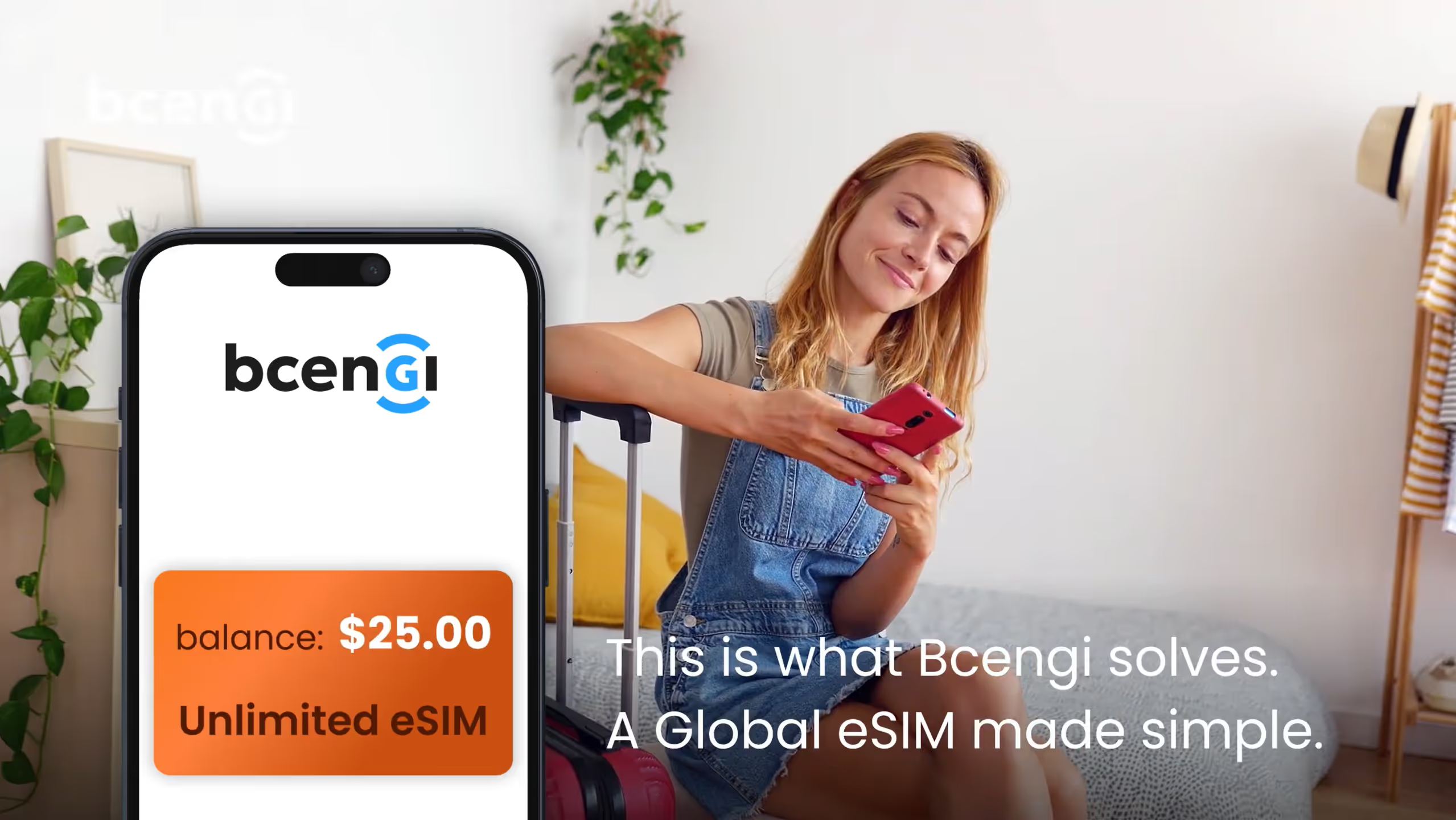

Personal Travel
Personal Travel




Pay As You Go
from
$
/GB
$10
POPULAR
$25
$50
$100
Select your starting balance
Get your eSIM
→

Your payment is fully secured |
Powered by

Rated
4.7


Install once, keep it on your phone.

Pay as you go, for actual use.

No fixed plans, no expiration.

Use balance only when you travel.

One eSIM for all trips, 200+ Countries.
Pay As You Go data, wherever you travel
💵 You add
$25
to your balance.
✈️ In
you use
3GB
at
$
/GB
.
🌍
South Africa
3 months later -
3GB at $
3.54
/GB.
🔥 Your same balance covers both trips -
one eSIM, no expiry, no wasted data, no new package.
Just $
per GB. No surprises, No bundles, No expiry.

Light Usage
~200 MB/day
$
0.00
/day
Maps, messaging, browsing

Moderate
~500 MB/day
$
0.00
/day

Heavy
~2 GB/day
$
0.00
/day
Streaming, uploads, video calls
Bujumbura: As the economic capital and largest city, Bujumbura offers the most reliable connectivity in the country. You'll find strong 4G coverage in the central business district (Centre Ville), along the Lake Tanganyika shores, and in major residential areas. Signal strength can weaken inside older, thick-walled concrete buildings or basements, but is generally excellent for urban use.
Gitega: In the nation's political capital, mobile coverage is generally strong, with 4G available in the city center and around key government buildings. The signal is reliable for most data needs within the main urban area. As you travel into the surrounding hills or further from the city core, the connection may revert to a stable 3G network.
Ngozi: A major northern city, Ngozi has dependable 3G coverage across its main areas, making it suitable for calls, messaging, and basic internet browsing. While 4G may be available in some central spots, it is not as widespread as in Bujumbura. Indoor coverage in busy markets or densely constructed buildings can sometimes be inconsistent.
Rumonge: This port city on Lake Tanganyika features good 3G connectivity, particularly in the town center and along the main RN3 coastal road. The network is generally reliable for communication and navigation. Signal strength might fluctuate slightly on the outskirts of the city or in more remote areas along the shoreline away from the main town.
Muyinga: In this key northeastern provincial capital, you can expect solid 3G coverage throughout the central urban zone. This is sufficient for essential communications and basic data usage. Connectivity becomes less predictable as you move into the rural areas immediately surrounding the city.



National Roads: Major routes like the RN1 (Bujumbura to the Rwandan border), RN5 (Bujumbura to Gitega), and RN3 (along Lake Tanganyika) have generally stable mobile coverage in and around major towns. However, expect intermittent signal loss and data speed reductions when traveling through the hilly rural landscapes between these urban centers.
Intercity Rail: Burundi does not have an operational passenger railway system. All intercity travel is conducted by road, so network connectivity is entirely dependent on the cellular tower infrastructure along the highway network.
Congo-Nile Divide: The mountainous spine of the country, known as the Congo-Nile Divide, presents the most significant challenge for continuous connectivity. Roads that traverse this range, particularly in provinces like Muramvya and Kayanza, are prone to extended periods of no service as you navigate the winding passes and valleys.
National Parks and Border Areas: Expect very limited to non-existent mobile signal within the dense forests of Kibira National Park in the northwest and the remote savannas of Ruvubu National Park in the northeast. Connectivity also weakens considerably in rural regions along the borders with Tanzania and the Democratic Republic of Congo.
Lake Tanganyika Shoreline: While the route south of Bujumbura along the lake (RN3) is heavily traveled, coverage can be inconsistent. The signal is strong near towns like Rumonge and Nyanza-Lac but can drop out completely in sections where the road passes between steep cliffs and the water, away from populated areas.
How it works
Buy eSIM
Sign up and get your Global eSIM in just a few clicks.

Activate eSIM
Scan the QR code and get connected instantly — no physical SIM needed.

Pay as you go
Only pay for what you use. No contracts, no hidden fees.

Get your eSIM
“
I loved the per-country pricing model. I only paid for the countries I visited, and it was way cheaper than other eSIM providers. No hidden fees — just clear and simple.
“
The auto top-up feature is a lifesaver. I never have to check my balance — internet just works. And when I’m not traveling, I don’t pay. It’s fair and super convenient.


Angel Siphron
Rated
4.7


Bcengi bills $280.54 per GB when utilizing Lumitel networks. You are charged solely for the data you consume, without any requirement for bundles or minimum expenditures.
No, there is no need to remove it. Bcengi functions alongside your current SIM card due to its dual-SIM capabilities. You can retain your usual SIM for making calls and sending text messages.
Yes, provided your smartphone offers eSIM support (which is common for most models released from 2019 onwards). To verify compatibility, please visit bcengi.com/travelpass/esim-compatibility.
Coverage is dependent on the Lumitel network's infrastructure. Strong signal is generally available in major urban centers and popular tourist destinations. Conversely, signal strength might be limited in more isolated geographical areas.
Most travelers typically use between 500 MB and 2 GB of data each day. For an average week, the total cost is approximately $981.89 when using pay-as-you-go rates.
Yes. A single Bcengi eSIM provides service in over 200 countries. Your remaining balance transfers across destinations, eliminating the need to acquire a new eSIM for each new place you visit.
You have the option to add funds at any time via travel.bcengi.com. Alternatively, you can activate the auto-refill feature to ensure your balance is continuously maintained.
No. Your Bcengi balance never lapses, regardless of whether you plan to use it in the upcoming week or the following year.

$
/GB

Instant delivery

No expiry

24/7 support

Secure checkout

Pay As You Go
from
$
/GB
$10
POPULAR
$25
$50
$100
Select your starting balance
Get your eSIM
→

Secure Payments |
Powered by

Rated
4.7


💵 You add
$25
to your balance.
✈️ In
you use
3GB
at
$
/GB
.
🌍
South Africa
3 months later -
3GB at $
3.54
/GB.
🔥 Your same balance covers both trips — one eSIM, no expiry, no wasted data, no new package.
How it works


Install once, keep it on your phone

Use balance only when you travel

Pay as you go, for actual use.

No fixed plans, no expiration

One eSIM for all trips, 200+ Countries.
Learn more
Just $
per GB.
No surprises, No bundles, No expiry.

Light Usage •
200 MB/day
$
0.00
/day
Maps, messaging, browsing

Moderate •
500 MB/day
$
0.00
/day

Heavy •
2 GB/day
$
0.00
/day
Streaming, uploads, video calls
Bujumbura: As the economic capital and largest city, Bujumbura offers the most reliable connectivity in the country. You'll find strong 4G coverage in the central business district (Centre Ville), along the Lake Tanganyika shores, and in major residential areas. Signal strength can weaken inside older, thick-walled concrete buildings or basements, but is generally excellent for urban use.
Gitega: In the nation's political capital, mobile coverage is generally strong, with 4G available in the city center and around key government buildings. The signal is reliable for most data needs within the main urban area. As you travel into the surrounding hills or further from the city core, the connection may revert to a stable 3G network.
Ngozi: A major northern city, Ngozi has dependable 3G coverage across its main areas, making it suitable for calls, messaging, and basic internet browsing. While 4G may be available in some central spots, it is not as widespread as in Bujumbura. Indoor coverage in busy markets or densely constructed buildings can sometimes be inconsistent.
Rumonge: This port city on Lake Tanganyika features good 3G connectivity, particularly in the town center and along the main RN3 coastal road. The network is generally reliable for communication and navigation. Signal strength might fluctuate slightly on the outskirts of the city or in more remote areas along the shoreline away from the main town.
Muyinga: In this key northeastern provincial capital, you can expect solid 3G coverage throughout the central urban zone. This is sufficient for essential communications and basic data usage. Connectivity becomes less predictable as you move into the rural areas immediately surrounding the city.
National Roads: Major routes like the RN1 (Bujumbura to the Rwandan border), RN5 (Bujumbura to Gitega), and RN3 (along Lake Tanganyika) have generally stable mobile coverage in and around major towns. However, expect intermittent signal loss and data speed reductions when traveling through the hilly rural landscapes between these urban centers.
Intercity Rail: Burundi does not have an operational passenger railway system. All intercity travel is conducted by road, so network connectivity is entirely dependent on the cellular tower infrastructure along the highway network.
Congo-Nile Divide: The mountainous spine of the country, known as the Congo-Nile Divide, presents the most significant challenge for continuous connectivity. Roads that traverse this range, particularly in provinces like Muramvya and Kayanza, are prone to extended periods of no service as you navigate the winding passes and valleys.
National Parks and Border Areas: Expect very limited to non-existent mobile signal within the dense forests of Kibira National Park in the northwest and the remote savannas of Ruvubu National Park in the northeast. Connectivity also weakens considerably in rural regions along the borders with Tanzania and the Democratic Republic of Congo.
Lake Tanganyika Shoreline: While the route south of Bujumbura along the lake (RN3) is heavily traveled, coverage can be inconsistent. The signal is strong near towns like Rumonge and Nyanza-Lac but can drop out completely in sections where the road passes between steep cliffs and the water, away from populated areas.
Learn more about
How it works

1. Buy eSIM
Sign up and get your Global eSIM in just a few clicks.

2. Activate eSIM
Scan the QR code and get connected instantly — no physical SIM needed.

3. Pay as you go
Only pay for what you use. No contracts, no hidden fees.
Get your eSIM
Rated
4.7
“
I loved the per-country pricing model. I only paid for the countries I visited, and it was way cheaper than other eSIM providers. No hidden fees — just clear and simple.


Kaylynn Mango


Bcengi bills $280.54 per GB when utilizing Lumitel networks. You are charged solely for the data you consume, without any requirement for bundles or minimum expenditures.
No, there is no need to remove it. Bcengi functions alongside your current SIM card due to its dual-SIM capabilities. You can retain your usual SIM for making calls and sending text messages.
Yes, provided your smartphone offers eSIM support (which is common for most models released from 2019 onwards). To verify compatibility, please visit bcengi.com/travelpass/esim-compatibility.
Coverage is dependent on the Lumitel network's infrastructure. Strong signal is generally available in major urban centers and popular tourist destinations. Conversely, signal strength might be limited in more isolated geographical areas.
Most travelers typically use between 500 MB and 2 GB of data each day. For an average week, the total cost is approximately $981.89 when using pay-as-you-go rates.
Yes. A single Bcengi eSIM provides service in over 200 countries. Your remaining balance transfers across destinations, eliminating the need to acquire a new eSIM for each new place you visit.
You have the option to add funds at any time via travel.bcengi.com. Alternatively, you can activate the auto-refill feature to ensure your balance is continuously maintained.
No. Your Bcengi balance never lapses, regardless of whether you plan to use it in the upcoming week or the following year.
$
/GB
Instant delivery

No expiry
24/7 support
Secure checkout

Bcengi TravelPass keeps you connected worldwide with one reusable eSIM - no expirations, no wasted data.


Settings
English

USD


Bcengi TravelPass keeps you connected worldwide with one reusable eSIM - no expirations, no wasted data.



Secure Payments | Powered by