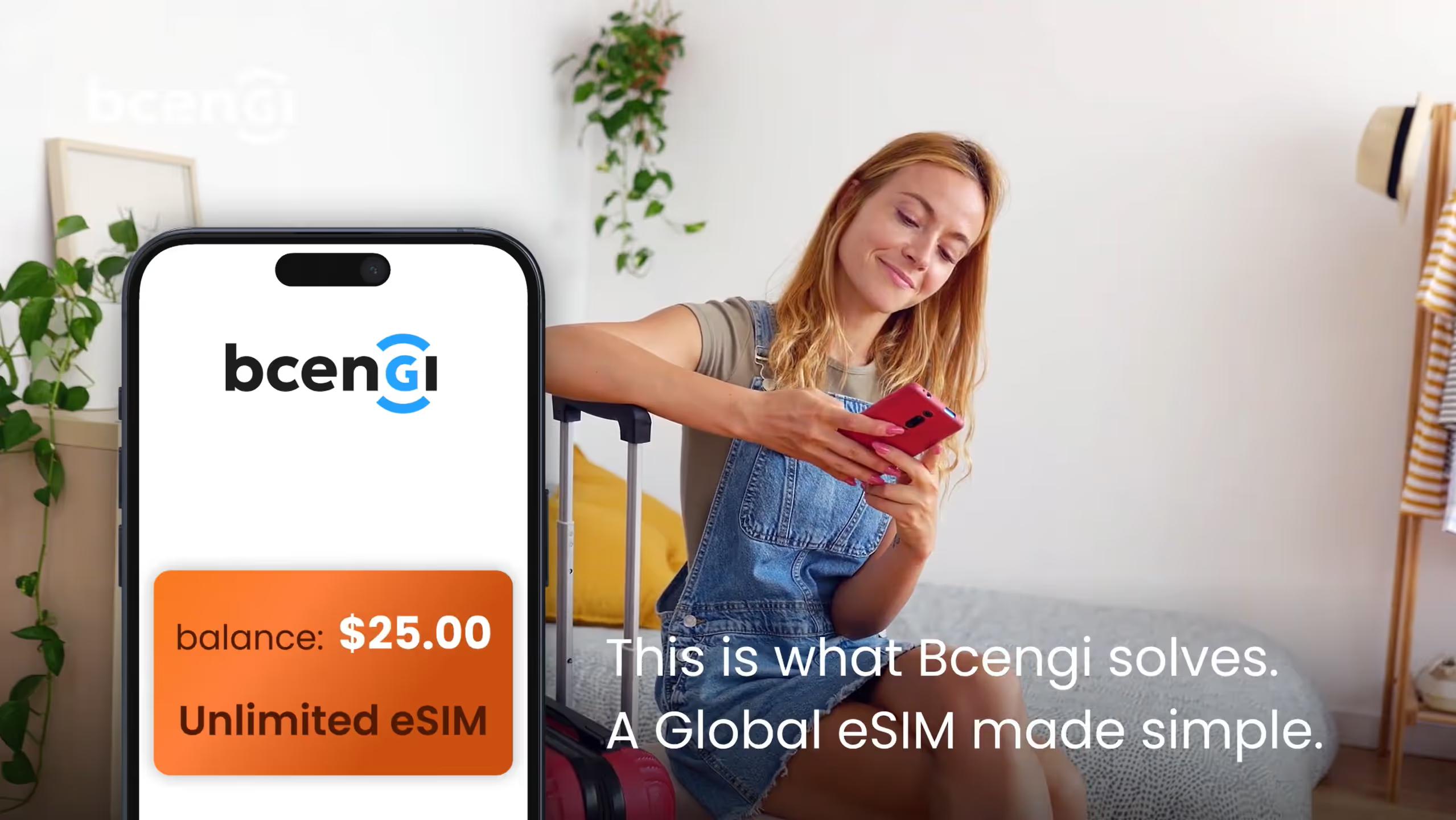

Personal Travel
Personal Travel



Cameroon

Orange
Pay As You Go
from
$
7.35
/GB
$10
POPULAR
$25
$50
$100
Select your starting balance
Get your eSIM
→

Your payment is fully secured |
Powered by

Rated
4.7


Install once, keep it on your phone.

Pay as you go, for actual use.

No fixed plans, no expiration.

Use balance only when you travel.

One eSIM for all trips, 200+ Countries.
Pay As You Go data, wherever you travel
💵 You add
$25
to your balance.
✈️ In
Cameroon
you use
3GB
at
$
7.35
/GB
.
🌍
South Africa
3 months later -
3GB at $
3.54
/GB.
🔥 Your same balance covers both trips -
one eSIM, no expiry, no wasted data, no new package.
Just $
7.35
per GB. No surprises, No bundles, No expiry.

Light Usage
~200 MB/day
$
0.00
/day
Maps, messaging, browsing

Moderate
~500 MB/day
$
0.00
/day

Heavy
~2 GB/day
$
0.00
/day
Streaming, uploads, video calls
Douala: As Cameroon's economic capital, Douala boasts reliable 4G coverage from major providers, especially in business districts such as Akwa and Bonapriso. Connections are strong in most hotels and commercial centers. However, signal strength can decrease inside older, dense concrete buildings, and you may experience network congestion in crowded areas like the Mboppi Market.
Yaoundé: The capital city offers widespread 4G connectivity, particularly in the central administrative district, the Bastos neighborhood, and around major tourist sites. Due to the city's hilly terrain, you might find some pockets of weaker signal in certain valleys or lower-lying areas. Indoor coverage is generally good in modern structures but can be less consistent in buildings with thick walls.
Limbe: This coastal city, popular with tourists, has good mobile coverage in the town center and along the primary beachfront areas near the Botanical Garden. The connection is generally stable for browsing and calls. As you travel further from the main town towards the slopes of Mount Cameroon or more isolated beaches, the signal can become intermittent.
Kribi: Known for its stunning beaches and the Lobé Waterfalls, Kribi provides dependable network access in the main town and its numerous beachside resorts. You can expect a good 4G signal for most typical uses. The connection becomes less reliable the further you venture from populated tourist zones, especially when exploring areas further down the coast or inland.
Bafoussam: In the heart of the West Region, Bafoussam has solid network coverage in its commercial center and along the main arterial roads. Service is reliable for everyday communication within the city limits. However, indoor penetration can be a challenge in buildings constructed with traditional, thick materials, and coverage thins out quickly as you enter the surrounding rural areas.



Major National Roads: The N3 highway corridor connecting Douala and Yaoundé provides the most reliable mobile coverage in the country. Signal quality degrades significantly on other primary routes like the N1 heading into the Adamawa and northern regions, and the N2 towards the southern border, with frequent service gaps in rural stretches between towns.
Camrail Intercity Train: On the main passenger rail line, service is generally consistent on the busy southern leg between Douala and Yaoundé. However, on the northern section from Yaoundé to Ngaoundéré, the train travels through vast, sparsely populated areas, leading to extended periods of weak or completely absent mobile signal.
Western High Plateau: Traveling through the mountainous terrain of the Western High Plateau, including the roads around Bamenda and Bafoussam, involves frequent changes in elevation and winding routes. This results in highly intermittent connectivity, with signal often dropping out entirely on regional roads connecting smaller towns and villages.
Southeastern Rainforest Region: Any journey deep into the East and South Regions, which are dominated by the Congo Basin rainforest, guarantees a near-total loss of mobile signal. Connectivity is extremely limited to a few major towns, and travel to national parks like Lobéké or Dja Faunal Reserve means being completely offline.
Far North Region: While the N1 highway provides a basic connectivity spine up to Maroua, coverage in the Far North is generally sparse. Venturing off the main road, especially towards the Mandara Mountains or areas near Waza National Park, will result in a quick loss of network service.
How it works
Buy eSIM
Sign up and get your Global eSIM in just a few clicks.

Activate eSIM
Scan the QR code and get connected instantly — no physical SIM needed.

Pay as you go
Only pay for what you use. No contracts, no hidden fees.

Get your eSIM
“
I loved the per-country pricing model. I only paid for the countries I visited, and it was way cheaper than other eSIM providers. No hidden fees — just clear and simple.
“
The auto top-up feature is a lifesaver. I never have to check my balance — internet just works. And when I’m not traveling, I don’t pay. It’s fair and super convenient.


Angel Siphron
Rated
4.7


Data with Bcengi costs $7.35 per gigabyte when using Orange networks. Payment is solely for consumed data, with no required bundles or minimum expenditure.
No, it is not. Bcengi operates concurrently with your current SIM card, thanks to dual-SIM capabilities. You can retain your usual SIM for voice calls and SMS messages.
Yes, provided your smartphone supports eSIM technology, which applies to most models released from 2019 onwards. Verify device compatibility at bcengi.com/travelpass/esim-compatibility.
Service availability relies on the Orange network's infrastructure. Robust coverage is generally found in key cities and popular tourist destinations, while signal can be restricted in more isolated regions.
A majority of visitors consume between 500 MB and 2 GB of data daily. For a week of moderate use, the cost is around $25.72 under the pay-as-you-go model.
Yes, indeed. A single Bcengi eSIM functions in over 200 nations. Your remaining balance transfers, eliminating the requirement to purchase a separate eSIM for every new location.
You have the option to add funds at any moment via travel.bcengi.com, or activate auto-refill to ensure your balance remains continuously available.
No, it will not. Your Bcengi balance holds indefinite validity, regardless of whether you utilize it in the upcoming week or the following year.

$
7.35
/GB

Instant delivery

No expiry

24/7 support

Secure checkout

Pay As You Go
from
$
7.35
/GB
$10
POPULAR
$25
$50
$100
Select your starting balance
Get your eSIM
→

Secure Payments |
Powered by

Rated
4.7


💵 You add
$25
to your balance.
✈️ In
Cameroon
you use
3GB
at
$
7.35
/GB
.
🌍
South Africa
3 months later -
3GB at $
3.54
/GB.
🔥 Your same balance covers both trips — one eSIM, no expiry, no wasted data, no new package.
How it works


Install once, keep it on your phone

Use balance only when you travel

Pay as you go, for actual use.

No fixed plans, no expiration

One eSIM for all trips, 200+ Countries.
Learn more
Just $
7.35
per GB.
No surprises, No bundles, No expiry.

Light Usage •
200 MB/day
$
0.00
/day
Maps, messaging, browsing

Moderate •
500 MB/day
$
0.00
/day

Heavy •
2 GB/day
$
0.00
/day
Streaming, uploads, video calls
Douala: As Cameroon's economic capital, Douala boasts reliable 4G coverage from major providers, especially in business districts such as Akwa and Bonapriso. Connections are strong in most hotels and commercial centers. However, signal strength can decrease inside older, dense concrete buildings, and you may experience network congestion in crowded areas like the Mboppi Market.
Yaoundé: The capital city offers widespread 4G connectivity, particularly in the central administrative district, the Bastos neighborhood, and around major tourist sites. Due to the city's hilly terrain, you might find some pockets of weaker signal in certain valleys or lower-lying areas. Indoor coverage is generally good in modern structures but can be less consistent in buildings with thick walls.
Limbe: This coastal city, popular with tourists, has good mobile coverage in the town center and along the primary beachfront areas near the Botanical Garden. The connection is generally stable for browsing and calls. As you travel further from the main town towards the slopes of Mount Cameroon or more isolated beaches, the signal can become intermittent.
Kribi: Known for its stunning beaches and the Lobé Waterfalls, Kribi provides dependable network access in the main town and its numerous beachside resorts. You can expect a good 4G signal for most typical uses. The connection becomes less reliable the further you venture from populated tourist zones, especially when exploring areas further down the coast or inland.
Bafoussam: In the heart of the West Region, Bafoussam has solid network coverage in its commercial center and along the main arterial roads. Service is reliable for everyday communication within the city limits. However, indoor penetration can be a challenge in buildings constructed with traditional, thick materials, and coverage thins out quickly as you enter the surrounding rural areas.
Major National Roads: The N3 highway corridor connecting Douala and Yaoundé provides the most reliable mobile coverage in the country. Signal quality degrades significantly on other primary routes like the N1 heading into the Adamawa and northern regions, and the N2 towards the southern border, with frequent service gaps in rural stretches between towns.
Camrail Intercity Train: On the main passenger rail line, service is generally consistent on the busy southern leg between Douala and Yaoundé. However, on the northern section from Yaoundé to Ngaoundéré, the train travels through vast, sparsely populated areas, leading to extended periods of weak or completely absent mobile signal.
Western High Plateau: Traveling through the mountainous terrain of the Western High Plateau, including the roads around Bamenda and Bafoussam, involves frequent changes in elevation and winding routes. This results in highly intermittent connectivity, with signal often dropping out entirely on regional roads connecting smaller towns and villages.
Southeastern Rainforest Region: Any journey deep into the East and South Regions, which are dominated by the Congo Basin rainforest, guarantees a near-total loss of mobile signal. Connectivity is extremely limited to a few major towns, and travel to national parks like Lobéké or Dja Faunal Reserve means being completely offline.
Far North Region: While the N1 highway provides a basic connectivity spine up to Maroua, coverage in the Far North is generally sparse. Venturing off the main road, especially towards the Mandara Mountains or areas near Waza National Park, will result in a quick loss of network service.
Learn more about
Cameroon
How it works

1. Buy eSIM
Sign up and get your Global eSIM in just a few clicks.

2. Activate eSIM
Scan the QR code and get connected instantly — no physical SIM needed.

3. Pay as you go
Only pay for what you use. No contracts, no hidden fees.
Get your eSIM
Rated
4.7
“
I loved the per-country pricing model. I only paid for the countries I visited, and it was way cheaper than other eSIM providers. No hidden fees — just clear and simple.


Kaylynn Mango


Data with Bcengi costs $7.35 per gigabyte when using Orange networks. Payment is solely for consumed data, with no required bundles or minimum expenditure.
No, it is not. Bcengi operates concurrently with your current SIM card, thanks to dual-SIM capabilities. You can retain your usual SIM for voice calls and SMS messages.
Yes, provided your smartphone supports eSIM technology, which applies to most models released from 2019 onwards. Verify device compatibility at bcengi.com/travelpass/esim-compatibility.
Service availability relies on the Orange network's infrastructure. Robust coverage is generally found in key cities and popular tourist destinations, while signal can be restricted in more isolated regions.
A majority of visitors consume between 500 MB and 2 GB of data daily. For a week of moderate use, the cost is around $25.72 under the pay-as-you-go model.
Yes, indeed. A single Bcengi eSIM functions in over 200 nations. Your remaining balance transfers, eliminating the requirement to purchase a separate eSIM for every new location.
You have the option to add funds at any moment via travel.bcengi.com, or activate auto-refill to ensure your balance remains continuously available.
No, it will not. Your Bcengi balance holds indefinite validity, regardless of whether you utilize it in the upcoming week or the following year.
$
7.35
/GB
Instant delivery

No expiry
24/7 support
Secure checkout

Bcengi TravelPass keeps you connected worldwide with one reusable eSIM - no expirations, no wasted data.


Settings
English

USD


Bcengi TravelPass keeps you connected worldwide with one reusable eSIM - no expirations, no wasted data.



Secure Payments | Powered by