
Personal Travel
Personal Travel



Faroe Islands

VODAFONE FO
Pay As You Go
from
$
3.07
/GB
$10
POPULAR
$25
$50
$100
Select your starting balance
Get your eSIM
→

Your payment is fully secured |
Powered by

Rated
4.7


Install once, keep it on your phone.

Pay as you go, for actual use.

No fixed plans, no expiration.

Use balance only when you travel.

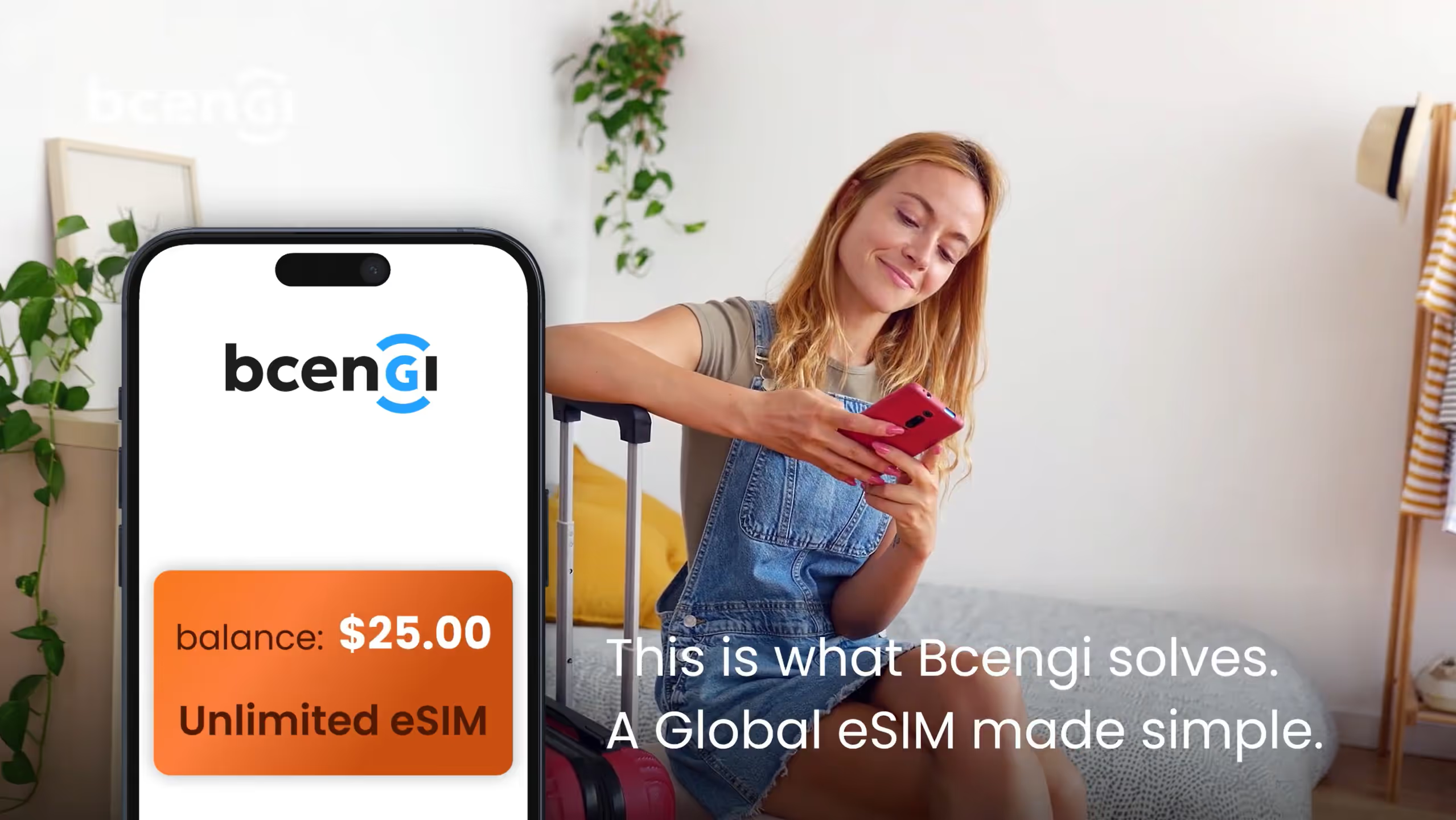
One eSIM for all trips, 200+ Countries.
Pay As You Go data, wherever you travel
💵 You add
$25
to your balance.
✈️ In
Faroe Islands
you use
3GB
at
$
3.07
/GB
.
🌍
Spain
3 months later -
3GB at $
1.19
/GB.
🔥 Your same balance covers both trips -
one eSIM, no expiry, no wasted data, no new package.
Just $
3.07
per GB. No surprises, No bundles, No expiry.

Light Usage
~200 MB/day
$
0.00
/day
Maps, messaging, browsing

Moderate
~500 MB/day
$
0.00
/day

Heavy
~2 GB/day
$
0.00
/day
Streaming, uploads, video calls
Tórshavn: As the capital, you'll find excellent 4G and growing 5G coverage throughout the city center, the harbour, and the historic Tinganes district. Indoor signal in hotels and cafes is generally strong. The primary connectivity challenge is not within the city but in the sub-sea tunnels connecting the islands, though major routes like the Eysturoyartunnilin are equipped with cellular repeaters for continuous service.
Klaksvík: The second-largest city in the Faroe Islands offers reliable 4G connectivity across its core urban and port areas. Your connection should remain stable when travelling to Klaksvík through the Norðoyatunnilin, a long sub-sea tunnel which is equipped with modern cellular infrastructure to prevent signal loss.
Miðvágur: Situated on the island of Vágar near the airport, Miðvágur has robust network coverage, ensuring you are connected upon arrival. While the town itself is well-covered, signal can become less consistent on nearby hiking trails like the one to the Sørvágsvatn "floating lake" viewpoint, particularly in valleys or areas shielded by cliffs.
Vestmanna: This key tourist town has good mobile signal for all pre-trip needs. However, during the popular boat tours to the Vestmanna bird cliffs, expect your signal to become intermittent or drop out entirely as the boat navigates between high sea stacks and into deep grottos, away from the direct line-of-sight of mainland cell towers.
Runavík: Along the Skálafjørður fjord, the town of Runavík and its neighbouring settlements have solid 4G coverage. It serves as a major hub connected by the Eysturoyartunnilin, where cellular service is generally maintained throughout the tunnel's length, including its unique underwater roundabout.



Main Island Roads: The primary road network connecting the main islands of Streymoy, Eysturoy, and Vágar (including the route to the airport) offers generally reliable 4G coverage. You may experience brief signal drops in very remote stretches between towns, but the connection is typically strong along the main arteries connecting Tórshavn, Klaksvík, and other major settlements.
Sub-sea Tunnels: A key feature of Faroese travel, the major sub-sea tunnels like Eysturoyartunnilin, Vágatunnilin, and Norðoyatunnilin are equipped with mobile signal repeaters. This ensures you maintain a continuous 4G connection while driving deep beneath the North Atlantic, allowing for uninterrupted navigation and streaming between islands.
Scenic Mountain Roads: While most major routes now use tunnels, the older scenic roads that travel over the mountains often lack consistent mobile service. On routes like the old road from Tórshavn over Norðadalsskarð, expect intermittent or no signal due to the high altitude and obstructive terrain, so download maps beforehand.
Remote Islands and Fjords: Signal becomes less predictable when visiting more isolated areas. While villages on islands like Mykines, Kalsoy, or Fugloy have local coverage, the signal often disappears completely on hiking trails between them or in deep, narrow fjords like the one leading to Saksun.
Inter-island Ferries: On ferry crossings, especially the two-hour journey to the southern island of Suðuroy, mobile signal is only available near the departure and arrival ports (Tórshavn and Tvøroyri). For the majority of the time at sea, you should expect to have no connection until you are close to land again.
How it works
Buy eSIM
Sign up and get your Global eSIM in just a few clicks.

Activate eSIM
Scan the QR code and get connected instantly — no physical SIM needed.

Pay as you go
Only pay for what you use. No contracts, no hidden fees.

Get your eSIM
“
I loved the per-country pricing model. I only paid for the countries I visited, and it was way cheaper than other eSIM providers. No hidden fees — just clear and simple.
“
The auto top-up feature is a lifesaver. I never have to check my balance — internet just works. And when I’m not traveling, I don’t pay. It’s fair and super convenient.


Angel Siphron
Rated
4.7


Bcengi offers eSIM data for $3.07 per gigabyte when connected to VODAFONE FO networks. Customers are billed solely for their data consumption; there are no fixed bundles or mandatory minimum expenditures.
No. Bcengi operates concurrently with your current SIM through dual-SIM functionality. You can retain your usual SIM card for making calls and sending messages.
Yes, provided your device has eSIM support (this includes the majority of smartphones manufactured from 2019 onwards). Verify device compatibility at bcengi.com/travelpass/esim-compatibility.
Coverage is determined by the VODAFONE FO network's infrastructure. While robust signal is generally found in principal cities and popular visitor destinations, signal strength might be restricted in more isolated regions.
The majority of travelers typically consume between 500 MB and 2 GB of data daily. For a week of moderate usage, the approximate cost is $10.74, based on pay-as-you-go rates.
Absolutely. A single Bcengi eSIM is functional in over 200 nations. Your remaining balance transfers, eliminating the need to acquire a new eSIM for every location you visit.
You have the option to add funds at any moment via travel.bcengi.com, or activate the auto-refill feature to ensure your balance remains continuously available.
No. Your Bcengi balance does not expire, regardless of whether you access it in the coming week or the following year.

$
3.07
/GB

Instant delivery

No expiry

24/7 support

Secure checkout

Pay As You Go
from
$
3.07
/GB
$10
POPULAR
$25
$50
$100
Select your starting balance
Get your eSIM
→

Secure Payments |
Powered by

Rated
4.7


💵 You add
$25
to your balance.
✈️ In
Faroe Islands
you use
3GB
at
$
3.07
/GB
.
🌍
Spain
3 months later -
3GB at $
1.19
/GB.
🔥 Your same balance covers both trips — one eSIM, no expiry, no wasted data, no new package.
How it works


Install once, keep it on your phone

Use balance only when you travel

Pay as you go, for actual use.

No fixed plans, no expiration

One eSIM for all trips, 200+ Countries.
Learn more
Just $
3.07
per GB.
No surprises, No bundles, No expiry.

Light Usage •
200 MB/day
$
0.00
/day
Maps, messaging, browsing

Moderate •
500 MB/day
$
0.00
/day

Heavy •
2 GB/day
$
0.00
/day
Streaming, uploads, video calls
Tórshavn: As the capital, you'll find excellent 4G and growing 5G coverage throughout the city center, the harbour, and the historic Tinganes district. Indoor signal in hotels and cafes is generally strong. The primary connectivity challenge is not within the city but in the sub-sea tunnels connecting the islands, though major routes like the Eysturoyartunnilin are equipped with cellular repeaters for continuous service.
Klaksvík: The second-largest city in the Faroe Islands offers reliable 4G connectivity across its core urban and port areas. Your connection should remain stable when travelling to Klaksvík through the Norðoyatunnilin, a long sub-sea tunnel which is equipped with modern cellular infrastructure to prevent signal loss.
Miðvágur: Situated on the island of Vágar near the airport, Miðvágur has robust network coverage, ensuring you are connected upon arrival. While the town itself is well-covered, signal can become less consistent on nearby hiking trails like the one to the Sørvágsvatn "floating lake" viewpoint, particularly in valleys or areas shielded by cliffs.
Vestmanna: This key tourist town has good mobile signal for all pre-trip needs. However, during the popular boat tours to the Vestmanna bird cliffs, expect your signal to become intermittent or drop out entirely as the boat navigates between high sea stacks and into deep grottos, away from the direct line-of-sight of mainland cell towers.
Runavík: Along the Skálafjørður fjord, the town of Runavík and its neighbouring settlements have solid 4G coverage. It serves as a major hub connected by the Eysturoyartunnilin, where cellular service is generally maintained throughout the tunnel's length, including its unique underwater roundabout.
Main Island Roads: The primary road network connecting the main islands of Streymoy, Eysturoy, and Vágar (including the route to the airport) offers generally reliable 4G coverage. You may experience brief signal drops in very remote stretches between towns, but the connection is typically strong along the main arteries connecting Tórshavn, Klaksvík, and other major settlements.
Sub-sea Tunnels: A key feature of Faroese travel, the major sub-sea tunnels like Eysturoyartunnilin, Vágatunnilin, and Norðoyatunnilin are equipped with mobile signal repeaters. This ensures you maintain a continuous 4G connection while driving deep beneath the North Atlantic, allowing for uninterrupted navigation and streaming between islands.
Scenic Mountain Roads: While most major routes now use tunnels, the older scenic roads that travel over the mountains often lack consistent mobile service. On routes like the old road from Tórshavn over Norðadalsskarð, expect intermittent or no signal due to the high altitude and obstructive terrain, so download maps beforehand.
Remote Islands and Fjords: Signal becomes less predictable when visiting more isolated areas. While villages on islands like Mykines, Kalsoy, or Fugloy have local coverage, the signal often disappears completely on hiking trails between them or in deep, narrow fjords like the one leading to Saksun.
Inter-island Ferries: On ferry crossings, especially the two-hour journey to the southern island of Suðuroy, mobile signal is only available near the departure and arrival ports (Tórshavn and Tvøroyri). For the majority of the time at sea, you should expect to have no connection until you are close to land again.
Learn more about
Faroe Islands
How it works

1. Buy eSIM
Sign up and get your Global eSIM in just a few clicks.

2. Activate eSIM
Scan the QR code and get connected instantly — no physical SIM needed.

3. Pay as you go
Only pay for what you use. No contracts, no hidden fees.
Get your eSIM
Rated
4.7
“
I loved the per-country pricing model. I only paid for the countries I visited, and it was way cheaper than other eSIM providers. No hidden fees — just clear and simple.


Kaylynn Mango


Bcengi offers eSIM data for $3.07 per gigabyte when connected to VODAFONE FO networks. Customers are billed solely for their data consumption; there are no fixed bundles or mandatory minimum expenditures.
No. Bcengi operates concurrently with your current SIM through dual-SIM functionality. You can retain your usual SIM card for making calls and sending messages.
Yes, provided your device has eSIM support (this includes the majority of smartphones manufactured from 2019 onwards). Verify device compatibility at bcengi.com/travelpass/esim-compatibility.
Coverage is determined by the VODAFONE FO network's infrastructure. While robust signal is generally found in principal cities and popular visitor destinations, signal strength might be restricted in more isolated regions.
The majority of travelers typically consume between 500 MB and 2 GB of data daily. For a week of moderate usage, the approximate cost is $10.74, based on pay-as-you-go rates.
Absolutely. A single Bcengi eSIM is functional in over 200 nations. Your remaining balance transfers, eliminating the need to acquire a new eSIM for every location you visit.
You have the option to add funds at any moment via travel.bcengi.com, or activate the auto-refill feature to ensure your balance remains continuously available.
No. Your Bcengi balance does not expire, regardless of whether you access it in the coming week or the following year.
$
3.07
/GB
Instant delivery

No expiry
24/7 support
Secure checkout

Bcengi TravelPass keeps you connected worldwide with one reusable eSIM - no expirations, no wasted data.


Settings
English

USD


Bcengi TravelPass keeps you connected worldwide with one reusable eSIM - no expirations, no wasted data.



Secure Payments | Powered by