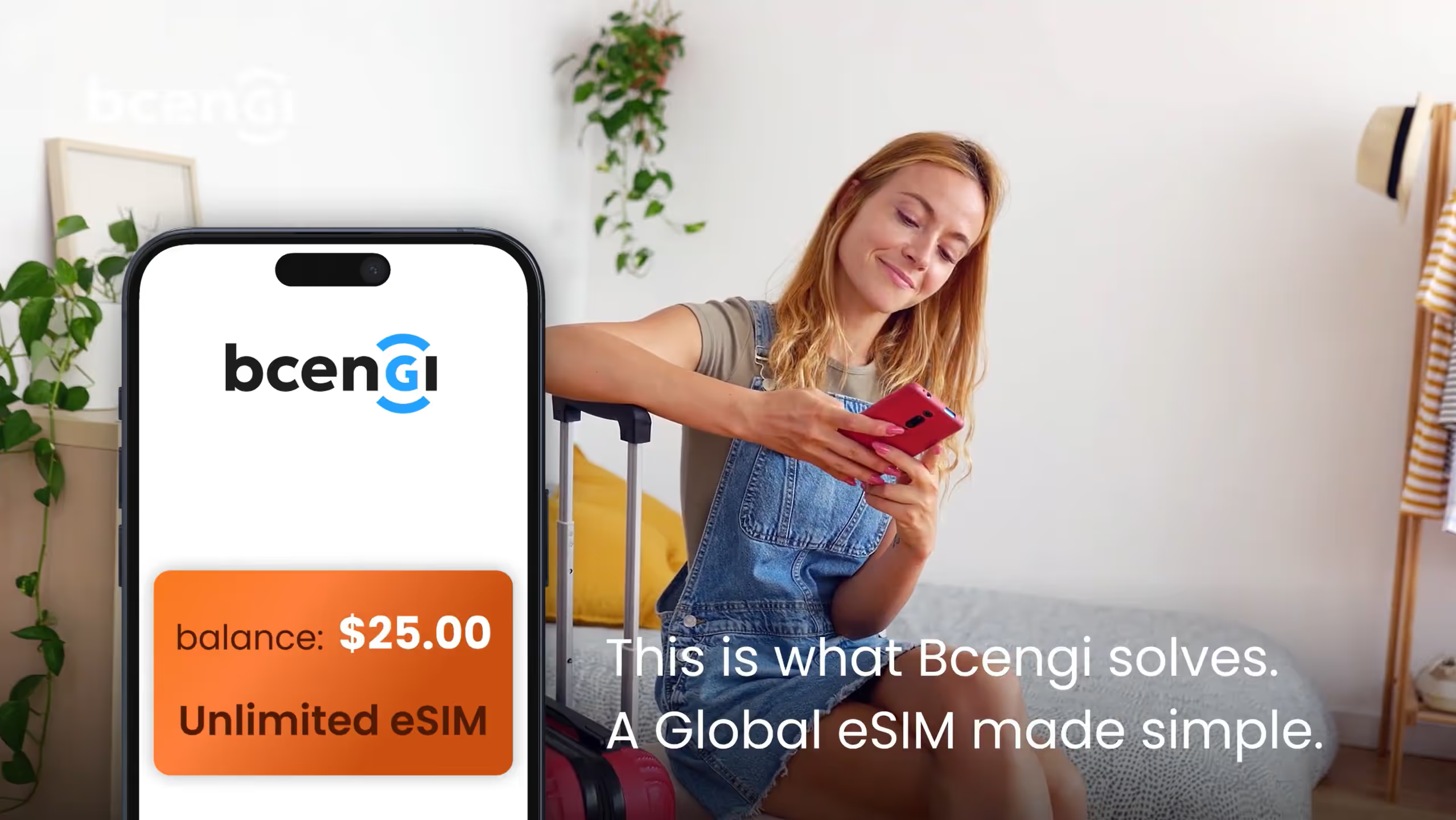

Personal Travel
Personal Travel



Ghana

Airtel (formerly Zain), tiGO
Pay As You Go
from
$
3.89
/GB
$10
POPULAR
$25
$50
$100
Select your starting balance
Get your eSIM
→

Your payment is fully secured |
Powered by

Rated
4.7


Install once, keep it on your phone.

Pay as you go, for actual use.

No fixed plans, no expiration.

Use balance only when you travel.

One eSIM for all trips, 200+ Countries.
Pay As You Go data, wherever you travel
💵 You add
$25
to your balance.
✈️ In
Ghana
you use
3GB
at
$
3.89
/GB
.
🌍
United Kingdom
3 months later -
3GB at $
1.19
/GB.
🔥 Your same balance covers both trips -
one eSIM, no expiry, no wasted data, no new package.
Just $
3.89
per GB. No surprises, No bundles, No expiry.

Light Usage
~200 MB/day
$
0.00
/day
Maps, messaging, browsing

Moderate
~500 MB/day
$
0.00
/day

Heavy
~2 GB/day
$
0.00
/day
Streaming, uploads, video calls
Accra: As the nation's capital, Accra offers strong and reliable 4G LTE coverage across its main districts, including Osu, Airport City, and the central business district. Service is excellent in most tourist areas and along major transport routes. You may find weaker signal penetration inside large concrete structures like major shopping malls or in basement levels.
Kumasi: In Ghana's second-largest city, you'll find dependable 4G connectivity, particularly in the city center, around the bustling Kejetia Market, and on the KNUST university campus. While the core urban areas are well-served, signal strength can become less consistent in the sprawling residential neighborhoods on the city's periphery.
Cape Coast: This historic coastal city has good 4G coverage in the main town and university areas, catering to its significant tourist traffic. You will have a usable signal at major sites like Cape Coast Castle, but expect reception to drop significantly inside the thick stone walls of the historic forts. Coverage can be less stable in smaller villages along the coast outside the city.
Tamale: As the primary hub of Northern Ghana, central Tamale is well-covered by 4G networks, making navigation and communication straightforward. The service is strongest in the commercial center and along the main highways. As you move away from the city core into more rural surrounding areas, expect the network to drop to 3G or become less consistent.

Major National Highways (N1, N6): Coverage along the main coastal N1 highway (Accra-Cape Coast-Takoradi) and the N6 highway (Accra-Kumasi) is generally strong with 4G available in cities and larger towns. However, expect signal to weaken or drop to 3G in the rural segments between major population centers.
Northern Savannah Regions: Connectivity becomes considerably less reliable when travelling north of Kumasi and Techiman. While regional capitals like Tamale and Wa have decent service, the long stretches of highway between them on routes like the N10 and N2 often have extensive dead zones where no signal is available.
Akwapim-Togo Ranges: When driving through the hilly terrain of the Volta and Eastern Regions, particularly on the N2 highway, the topography can cause intermittent signal loss. Areas near natural attractions like Wli Waterfalls and Mount Afadja are known for having very poor to non-existent mobile reception.
National Parks and Forest Reserves: Do not expect reliable mobile service inside major conservation areas. Both Mole National Park in the north and Kakum National Park in the south have minimal to no network coverage, requiring visitors to rely on offline maps and plan communications accordingly.
Intercity Railway Lines: On the operational rail corridors, such as the Accra-Tema line, connectivity is generally stable. Service on the Western Line from Takoradi to Tarkwa can be less consistent, with potential signal drops as the train passes through rural and forested areas away from towns.
How it works
Buy eSIM
Sign up and get your Global eSIM in just a few clicks.

Activate eSIM
Scan the QR code and get connected instantly — no physical SIM needed.

Pay as you go
Only pay for what you use. No contracts, no hidden fees.

Get your eSIM
“
I loved the per-country pricing model. I only paid for the countries I visited, and it was way cheaper than other eSIM providers. No hidden fees — just clear and simple.
“
The auto top-up feature is a lifesaver. I never have to check my balance — internet just works. And when I’m not traveling, I don’t pay. It’s fair and super convenient.


Angel Siphron
Rated
4.7


Bcengi provides data at a rate of $3.89 per gigabyte across the Airtel (previously Zain) and tiGO networks. You are billed exclusively for the data consumed, with no requirement for purchasing bundles or meeting a minimum expenditure.
No. Bcengi operates concurrently with your current SIM through dual-SIM functionality. You can retain your standard SIM for making calls and sending text messages.
Yes, provided your smartphone supports eSIM technology, which includes most models released since 2019. Verify device compatibility at bcengi.com/travelpass/esim-compatibility.
Service availability is contingent upon the network infrastructure of Airtel (formerly Zain) and tiGO. You can generally expect robust coverage in prominent cities and popular tourist destinations. However, signal strength might be restricted in more isolated regions.
A typical traveler utilizes between 500 MB and 2 GB of data daily. For a standard week, the expense averages around $13.62 when using pay-as-you-go rates.
Yes. A single Bcengi eSIM is functional in over 200 nations. Your remaining balance transfers, eliminating the need to acquire a distinct eSIM for every new locale.
You have the option to add funds at any moment by visiting travel.bcengi.com, or you can activate an auto-refill feature to ensure your balance remains continuously available.
No. Your Bcengi balance holds indefinite validity, regardless of whether you access it in the coming week or the subsequent year.

$
3.89
/GB

Instant delivery

No expiry

24/7 support

Secure checkout

Pay As You Go
from
$
3.89
/GB
$10
POPULAR
$25
$50
$100
Select your starting balance
Get your eSIM
→

Secure Payments |
Powered by

Rated
4.7


💵 You add
$25
to your balance.
✈️ In
Ghana
you use
3GB
at
$
3.89
/GB
.
🌍
United Kingdom
3 months later -
3GB at $
1.19
/GB.
🔥 Your same balance covers both trips — one eSIM, no expiry, no wasted data, no new package.
How it works


Install once, keep it on your phone

Use balance only when you travel

Pay as you go, for actual use.

No fixed plans, no expiration

One eSIM for all trips, 200+ Countries.
Learn more
Just $
3.89
per GB.
No surprises, No bundles, No expiry.

Light Usage •
200 MB/day
$
0.00
/day
Maps, messaging, browsing

Moderate •
500 MB/day
$
0.00
/day

Heavy •
2 GB/day
$
0.00
/day
Streaming, uploads, video calls
Accra: As the nation's capital, Accra offers strong and reliable 4G LTE coverage across its main districts, including Osu, Airport City, and the central business district. Service is excellent in most tourist areas and along major transport routes. You may find weaker signal penetration inside large concrete structures like major shopping malls or in basement levels.
Kumasi: In Ghana's second-largest city, you'll find dependable 4G connectivity, particularly in the city center, around the bustling Kejetia Market, and on the KNUST university campus. While the core urban areas are well-served, signal strength can become less consistent in the sprawling residential neighborhoods on the city's periphery.
Cape Coast: This historic coastal city has good 4G coverage in the main town and university areas, catering to its significant tourist traffic. You will have a usable signal at major sites like Cape Coast Castle, but expect reception to drop significantly inside the thick stone walls of the historic forts. Coverage can be less stable in smaller villages along the coast outside the city.
Tamale: As the primary hub of Northern Ghana, central Tamale is well-covered by 4G networks, making navigation and communication straightforward. The service is strongest in the commercial center and along the main highways. As you move away from the city core into more rural surrounding areas, expect the network to drop to 3G or become less consistent.
Major National Highways (N1, N6): Coverage along the main coastal N1 highway (Accra-Cape Coast-Takoradi) and the N6 highway (Accra-Kumasi) is generally strong with 4G available in cities and larger towns. However, expect signal to weaken or drop to 3G in the rural segments between major population centers.
Northern Savannah Regions: Connectivity becomes considerably less reliable when travelling north of Kumasi and Techiman. While regional capitals like Tamale and Wa have decent service, the long stretches of highway between them on routes like the N10 and N2 often have extensive dead zones where no signal is available.
Akwapim-Togo Ranges: When driving through the hilly terrain of the Volta and Eastern Regions, particularly on the N2 highway, the topography can cause intermittent signal loss. Areas near natural attractions like Wli Waterfalls and Mount Afadja are known for having very poor to non-existent mobile reception.
National Parks and Forest Reserves: Do not expect reliable mobile service inside major conservation areas. Both Mole National Park in the north and Kakum National Park in the south have minimal to no network coverage, requiring visitors to rely on offline maps and plan communications accordingly.
Intercity Railway Lines: On the operational rail corridors, such as the Accra-Tema line, connectivity is generally stable. Service on the Western Line from Takoradi to Tarkwa can be less consistent, with potential signal drops as the train passes through rural and forested areas away from towns.
Learn more about
Ghana
How it works

1. Buy eSIM
Sign up and get your Global eSIM in just a few clicks.

2. Activate eSIM
Scan the QR code and get connected instantly — no physical SIM needed.

3. Pay as you go
Only pay for what you use. No contracts, no hidden fees.
Get your eSIM
Rated
4.7
“
I loved the per-country pricing model. I only paid for the countries I visited, and it was way cheaper than other eSIM providers. No hidden fees — just clear and simple.


Kaylynn Mango


Bcengi provides data at a rate of $3.89 per gigabyte across the Airtel (previously Zain) and tiGO networks. You are billed exclusively for the data consumed, with no requirement for purchasing bundles or meeting a minimum expenditure.
No. Bcengi operates concurrently with your current SIM through dual-SIM functionality. You can retain your standard SIM for making calls and sending text messages.
Yes, provided your smartphone supports eSIM technology, which includes most models released since 2019. Verify device compatibility at bcengi.com/travelpass/esim-compatibility.
Service availability is contingent upon the network infrastructure of Airtel (formerly Zain) and tiGO. You can generally expect robust coverage in prominent cities and popular tourist destinations. However, signal strength might be restricted in more isolated regions.
A typical traveler utilizes between 500 MB and 2 GB of data daily. For a standard week, the expense averages around $13.62 when using pay-as-you-go rates.
Yes. A single Bcengi eSIM is functional in over 200 nations. Your remaining balance transfers, eliminating the need to acquire a distinct eSIM for every new locale.
You have the option to add funds at any moment by visiting travel.bcengi.com, or you can activate an auto-refill feature to ensure your balance remains continuously available.
No. Your Bcengi balance holds indefinite validity, regardless of whether you access it in the coming week or the subsequent year.
$
3.89
/GB
Instant delivery

No expiry
24/7 support
Secure checkout

Bcengi TravelPass keeps you connected worldwide with one reusable eSIM - no expirations, no wasted data.


Settings
English

USD


Bcengi TravelPass keeps you connected worldwide with one reusable eSIM - no expirations, no wasted data.



Secure Payments | Powered by