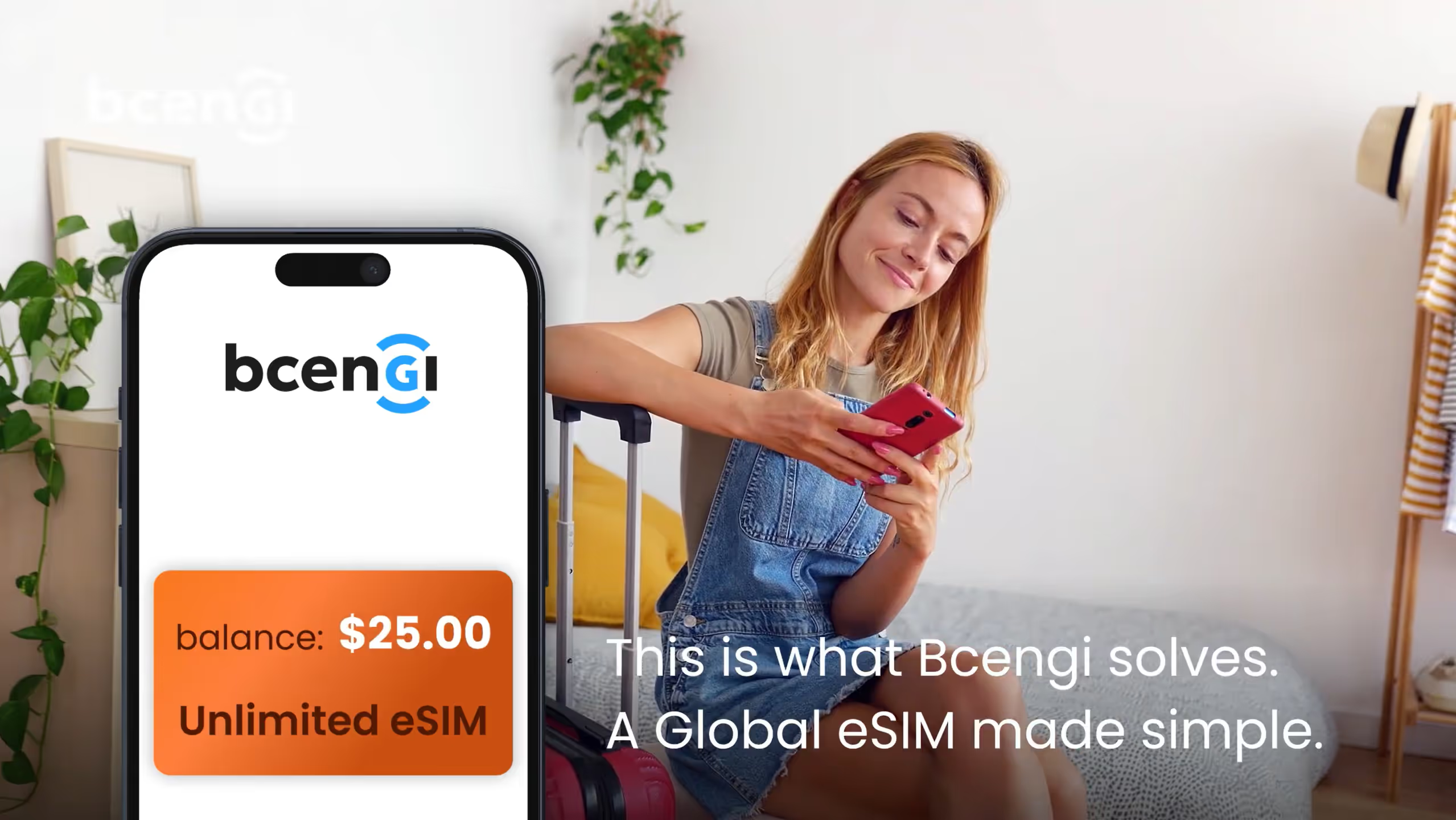

Personal Travel
Personal Travel



Mauritius

EMTEL, ORANGE MRU
Pay As You Go
from
$
13.57
/GB
$10
POPULAR
$25
$50
$100
Select your starting balance
Get your eSIM
→

Your payment is fully secured |
Powered by

Rated
4.7


Install once, keep it on your phone.

Pay as you go, for actual use.

No fixed plans, no expiration.

Use balance only when you travel.

One eSIM for all trips, 200+ Countries.
Pay As You Go data, wherever you travel
💵 You add
$25
to your balance.
✈️ In
Mauritius
you use
3GB
at
$
13.57
/GB
.
🌍
South Africa
3 months later -
3GB at $
3.54
/GB.
🔥 Your same balance covers both trips -
one eSIM, no expiry, no wasted data, no new package.
Just $
13.57
per GB. No surprises, No bundles, No expiry.

Light Usage
~200 MB/day
$
0.00
/day
Maps, messaging, browsing

Moderate
~500 MB/day
$
0.00
/day

Heavy
~2 GB/day
$
0.00
/day
Streaming, uploads, video calls
Port Louis: As the nation's capital, network coverage is excellent across the city center, the Caudan Waterfront, and business districts. The Metro Express light rail system, being almost entirely overground, offers a stable and continuous connection during transit. Indoor coverage in older colonial buildings with thick stone walls can sometimes be reduced, but is generally very reliable.
Grand Baie: This major northern tourist hub boasts robust 4G and 5G coverage, especially along the coastal road, in the main shopping areas like La Croisette, and on the public beaches. The network is well-optimised for the high concentration of users in hotels and restaurants, ensuring strong performance for maps and social media.
Flic en Flac: Expect strong, consistent mobile signal along the popular west coast beach, within the large resort complexes, and throughout the town's main commercial strip. The network is built to handle high tourist demand, though signal strength might dip slightly if you venture further inland into the surrounding sugar cane fields.
Mahébourg: This historic southeastern town, located close to SSR International Airport, has very good overall connectivity. You will find a reliable signal in the town center, along the waterfront, and in the popular nearby area of Blue Bay. While network density might be slightly lower than in Port Louis, it is more than sufficient for all typical travel needs.
Curepipe: Situated on the central plateau, this major residential and commercial town has comprehensive network coverage. The connection remains strong in the busy town center and along the Metro Express line that terminates here. Indoor coverage in some of the larger concrete shopping centers can occasionally be weaker on lower floors but is rarely problematic.



Major Motorways (M1, M2, M3): Connectivity is generally strong and reliable along Mauritius's main motorways, including the M1 linking the airport to Port Louis, the M2 servicing the north towards Grand Baie, and the M3 link road. Expect consistent 4G/LTE for navigation and streaming through these key corridors.
Metro Express Light Rail: The Metro Express line, connecting Port Louis with Curepipe and other central towns, offers excellent mobile coverage for the majority of the journey. The signal may briefly dip in some covered sections or underpasses but is quickly restored.
Central Plateau and Mountain Roads: When driving through the island's interior, particularly on smaller B-roads crossing the central plateau or near mountainous areas like Chamarel, expect intermittent signal. Coverage can become patchy or drop completely in these less populated, scenic regions.
Black River Gorges National Park: This remote and forested region in the southwest is a known area for poor mobile reception. While you might find a signal at higher viewpoints, coverage is largely absent within the gorges and on many of the hiking trails.
Road Tunnels: Short road tunnels, such as the one on the M3 motorway near Pailles, will cause a temporary loss of mobile signal. Service typically resumes immediately upon exiting the tunnel.
How it works
Buy eSIM
Sign up and get your Global eSIM in just a few clicks.

Activate eSIM
Scan the QR code and get connected instantly — no physical SIM needed.

Pay as you go
Only pay for what you use. No contracts, no hidden fees.

Get your eSIM
“
I loved the per-country pricing model. I only paid for the countries I visited, and it was way cheaper than other eSIM providers. No hidden fees — just clear and simple.
“
The auto top-up feature is a lifesaver. I never have to check my balance — internet just works. And when I’m not traveling, I don’t pay. It’s fair and super convenient.


Angel Siphron
Rated
4.7


For networks like EMTEL and ORANGE MRU, Bcengi applies a charge of $13.57 per gigabyte. You are billed solely for your actual data consumption, without any need for bundles or a minimum expenditure.
Not at all. Bcengi functions concurrently with your current SIM through dual-SIM capabilities. Your standard SIM remains active for making calls and sending messages.
Indeed, provided your specific device offers eSIM support (which includes the majority of handsets produced since 2019). You can verify device compatibility by visiting bcengi.com/travelpass/esim-compatibility.
Service availability relies on the network infrastructure of EMTEL and ORANGE MRU. You can generally expect robust coverage in primary urban centers and popular tourist destinations. However, signal strength might be restricted in more isolated regions.
The majority of travelers consume between 500 MB and 2 GB of data daily. For a week of moderate usage, the approximate cost with pay-as-you-go rates would be around $47.50.
Yes, it is. A single Bcengi eSIM provides service in over 200 nations. Your remaining balance is transferred, meaning there is no requirement to purchase a separate eSIM for every new place you visit.
You have the option to add funds whenever needed by visiting travel.bcengi.com, or you may activate auto-refill to ensure your balance remains continuously available.
No, there isn't. Your Bcengi account balance holds indefinite validity, whether you plan to utilize it in the near future or much later.

$
13.57
/GB

Instant delivery

No expiry

24/7 support

Secure checkout

Pay As You Go
from
$
13.57
/GB
$10
POPULAR
$25
$50
$100
Select your starting balance
Get your eSIM
→

Secure Payments |
Powered by

Rated
4.7


💵 You add
$25
to your balance.
✈️ In
Mauritius
you use
3GB
at
$
13.57
/GB
.
🌍
South Africa
3 months later -
3GB at $
3.54
/GB.
🔥 Your same balance covers both trips — one eSIM, no expiry, no wasted data, no new package.
How it works


Install once, keep it on your phone

Use balance only when you travel

Pay as you go, for actual use.

No fixed plans, no expiration

One eSIM for all trips, 200+ Countries.
Learn more
Just $
13.57
per GB.
No surprises, No bundles, No expiry.

Light Usage •
200 MB/day
$
0.00
/day
Maps, messaging, browsing

Moderate •
500 MB/day
$
0.00
/day

Heavy •
2 GB/day
$
0.00
/day
Streaming, uploads, video calls
Port Louis: As the nation's capital, network coverage is excellent across the city center, the Caudan Waterfront, and business districts. The Metro Express light rail system, being almost entirely overground, offers a stable and continuous connection during transit. Indoor coverage in older colonial buildings with thick stone walls can sometimes be reduced, but is generally very reliable.
Grand Baie: This major northern tourist hub boasts robust 4G and 5G coverage, especially along the coastal road, in the main shopping areas like La Croisette, and on the public beaches. The network is well-optimised for the high concentration of users in hotels and restaurants, ensuring strong performance for maps and social media.
Flic en Flac: Expect strong, consistent mobile signal along the popular west coast beach, within the large resort complexes, and throughout the town's main commercial strip. The network is built to handle high tourist demand, though signal strength might dip slightly if you venture further inland into the surrounding sugar cane fields.
Mahébourg: This historic southeastern town, located close to SSR International Airport, has very good overall connectivity. You will find a reliable signal in the town center, along the waterfront, and in the popular nearby area of Blue Bay. While network density might be slightly lower than in Port Louis, it is more than sufficient for all typical travel needs.
Curepipe: Situated on the central plateau, this major residential and commercial town has comprehensive network coverage. The connection remains strong in the busy town center and along the Metro Express line that terminates here. Indoor coverage in some of the larger concrete shopping centers can occasionally be weaker on lower floors but is rarely problematic.
Major Motorways (M1, M2, M3): Connectivity is generally strong and reliable along Mauritius's main motorways, including the M1 linking the airport to Port Louis, the M2 servicing the north towards Grand Baie, and the M3 link road. Expect consistent 4G/LTE for navigation and streaming through these key corridors.
Metro Express Light Rail: The Metro Express line, connecting Port Louis with Curepipe and other central towns, offers excellent mobile coverage for the majority of the journey. The signal may briefly dip in some covered sections or underpasses but is quickly restored.
Central Plateau and Mountain Roads: When driving through the island's interior, particularly on smaller B-roads crossing the central plateau or near mountainous areas like Chamarel, expect intermittent signal. Coverage can become patchy or drop completely in these less populated, scenic regions.
Black River Gorges National Park: This remote and forested region in the southwest is a known area for poor mobile reception. While you might find a signal at higher viewpoints, coverage is largely absent within the gorges and on many of the hiking trails.
Road Tunnels: Short road tunnels, such as the one on the M3 motorway near Pailles, will cause a temporary loss of mobile signal. Service typically resumes immediately upon exiting the tunnel.
Learn more about
Mauritius
How it works

1. Buy eSIM
Sign up and get your Global eSIM in just a few clicks.

2. Activate eSIM
Scan the QR code and get connected instantly — no physical SIM needed.

3. Pay as you go
Only pay for what you use. No contracts, no hidden fees.
Get your eSIM
Rated
4.7
“
I loved the per-country pricing model. I only paid for the countries I visited, and it was way cheaper than other eSIM providers. No hidden fees — just clear and simple.


Kaylynn Mango


For networks like EMTEL and ORANGE MRU, Bcengi applies a charge of $13.57 per gigabyte. You are billed solely for your actual data consumption, without any need for bundles or a minimum expenditure.
Not at all. Bcengi functions concurrently with your current SIM through dual-SIM capabilities. Your standard SIM remains active for making calls and sending messages.
Indeed, provided your specific device offers eSIM support (which includes the majority of handsets produced since 2019). You can verify device compatibility by visiting bcengi.com/travelpass/esim-compatibility.
Service availability relies on the network infrastructure of EMTEL and ORANGE MRU. You can generally expect robust coverage in primary urban centers and popular tourist destinations. However, signal strength might be restricted in more isolated regions.
The majority of travelers consume between 500 MB and 2 GB of data daily. For a week of moderate usage, the approximate cost with pay-as-you-go rates would be around $47.50.
Yes, it is. A single Bcengi eSIM provides service in over 200 nations. Your remaining balance is transferred, meaning there is no requirement to purchase a separate eSIM for every new place you visit.
You have the option to add funds whenever needed by visiting travel.bcengi.com, or you may activate auto-refill to ensure your balance remains continuously available.
No, there isn't. Your Bcengi account balance holds indefinite validity, whether you plan to utilize it in the near future or much later.
$
13.57
/GB
Instant delivery

No expiry
24/7 support
Secure checkout

Bcengi TravelPass keeps you connected worldwide with one reusable eSIM - no expirations, no wasted data.


Settings
English

USD


Bcengi TravelPass keeps you connected worldwide with one reusable eSIM - no expirations, no wasted data.



Secure Payments | Powered by