
Personal Travel
Personal Travel




Pay As You Go
from
$
/GB
$10
POPULAR
$25
$50
$100
Select your starting balance
Get your eSIM
→

Your payment is fully secured |
Powered by

Rated
4.7


Install once, keep it on your phone.

Pay as you go, for actual use.

No fixed plans, no expiration.

Use balance only when you travel.

One eSIM for all trips, 200+ Countries.
Pay As You Go data, wherever you travel
💵 You add
$25
to your balance.
✈️ In
you use
3GB
at
$
/GB
.
🌍
Australia
3 months later -
3GB at $
1.58
/GB.
🔥 Your same balance covers both trips -
one eSIM, no expiry, no wasted data, no new package.
Just $
per GB. No surprises, No bundles, No expiry.

Light Usage
~200 MB/day
$
0.00
/day
Maps, messaging, browsing

Moderate
~500 MB/day
$
0.00
/day

Heavy
~2 GB/day
$
0.00
/day
Streaming, uploads, video calls
Yaren: As the de facto capital, connectivity is strongest around the Parliament House and Nauru International Airport. The signal is generally reliable for both data and calls. Indoor coverage inside the concrete government buildings or the airport terminal can occasionally be weaker but remains functional for most needs.
Aiwo: Home to the main port, Aiwo District has strong network coverage around the harbour and processing facilities. The signal is robust along the main coastal road, though it can fluctuate slightly near the large industrial structures due to physical interference. Overall performance is good for general use.
Meneng: Coverage is excellent around the Menen Hotel and the surrounding coastal areas, which are popular with visitors. The network is well-optimised for this populated district, providing a stable connection for browsing and communication. Signal strength is most consistent along the main island ring road.
Buada: Located inland, the area around the scenic Buada Lagoon has a generally good signal, but it is noticeably less powerful than in the coastal districts. In the lower-lying, densely vegetated areas right next to the lagoon, your data connection may become intermittent, so it's best to complete any important downloads beforehand.


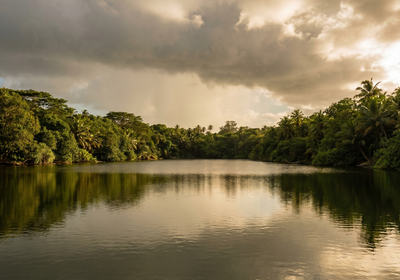
Island Ring Road: Nauru's main road is a 19-kilometer paved ring that circles the entire island along the coast, connecting all districts. Mobile coverage is generally consistent and strong along this entire loop as it passes through the most populated areas.
Nauru's Interior ("Topside"): The central, elevated plateau known as Topside is primarily a phosphate mining area and is less inhabited than the coast. Mobile signal can be weaker or less reliable in this inland region, especially away from the Buada Lagoon.
Phosphate Railway: An industrial, narrow-gauge railway runs a short distance from the interior mines to the coast. This is not a passenger line. As it operates within the less-populated Topside area, signal may be intermittent along its very brief route.
Coastal vs. Inland Areas: Due to Nauru's small size, there are no extensive dead zones between districts. Connectivity is strongest on the coastal plain where the population is concentrated. The only significant variation occurs when traveling inland to the central plateau, where the signal may weaken.
How it works
Buy eSIM
Sign up and get your Global eSIM in just a few clicks.

Activate eSIM
Scan the QR code and get connected instantly — no physical SIM needed.

Pay as you go
Only pay for what you use. No contracts, no hidden fees.

Get your eSIM
“
I loved the per-country pricing model. I only paid for the countries I visited, and it was way cheaper than other eSIM providers. No hidden fees — just clear and simple.
“
The auto top-up feature is a lifesaver. I never have to check my balance — internet just works. And when I’m not traveling, I don’t pay. It’s fair and super convenient.


Angel Siphron
Rated
4.7


Data from Bcengi is priced at $84.54 per gigabyte when utilized on Digicel (Nauru)'s networks. Payment is solely for your actual data consumption, without any required bundles or minimum expenditure.
No, it's not necessary. Bcengi operates concurrently with your current SIM through its dual-SIM functionality. You can retain your primary SIM card for traditional phone calls and sending text messages.
Indeed, provided your smartphone supports eSIM capabilities (this includes most models manufactured from 2019 onward). Verify device compatibility by visiting bcengi.com/travelpass/esim-compatibility.
Service availability relies on the existing network infrastructure of Digicel (Nauru). Generally, you'll find robust signal strength in principal urban centers and popular visitor destinations. However, expect restricted or weaker signals in less populated regions.
The majority of visitors typically consume between 500 MB and 2 GB of data daily. For a typical week, the estimated cost using pay-as-you-go rates is around $295.89.
Absolutely. A single Bcengi eSIM is functional in over 200 nations worldwide. Your remaining balance is transferable, eliminating the requirement to purchase a separate eSIM for every new location.
Replenishing your balance is possible at any moment by visiting travel.bcengi.com, or you can activate an auto-refill feature to ensure uninterrupted service.
No, it does not. Your Bcengi account credit remains valid indefinitely, regardless of whether you access it in the near future or much later.

$
/GB

Instant delivery

No expiry

24/7 support

Secure checkout

Pay As You Go
from
$
/GB
$10
POPULAR
$25
$50
$100
Select your starting balance
Get your eSIM
→

Secure Payments |
Powered by

Rated
4.7


💵 You add
$25
to your balance.
✈️ In
you use
3GB
at
$
/GB
.
🌍
Australia
3 months later -
3GB at $
1.58
/GB.
🔥 Your same balance covers both trips — one eSIM, no expiry, no wasted data, no new package.
How it works


Install once, keep it on your phone

Use balance only when you travel

Pay as you go, for actual use.

No fixed plans, no expiration

One eSIM for all trips, 200+ Countries.
Learn more
Just $
per GB.
No surprises, No bundles, No expiry.

Light Usage •
200 MB/day
$
0.00
/day
Maps, messaging, browsing

Moderate •
500 MB/day
$
0.00
/day

Heavy •
2 GB/day
$
0.00
/day
Streaming, uploads, video calls
Yaren: As the de facto capital, connectivity is strongest around the Parliament House and Nauru International Airport. The signal is generally reliable for both data and calls. Indoor coverage inside the concrete government buildings or the airport terminal can occasionally be weaker but remains functional for most needs.
Aiwo: Home to the main port, Aiwo District has strong network coverage around the harbour and processing facilities. The signal is robust along the main coastal road, though it can fluctuate slightly near the large industrial structures due to physical interference. Overall performance is good for general use.
Meneng: Coverage is excellent around the Menen Hotel and the surrounding coastal areas, which are popular with visitors. The network is well-optimised for this populated district, providing a stable connection for browsing and communication. Signal strength is most consistent along the main island ring road.
Buada: Located inland, the area around the scenic Buada Lagoon has a generally good signal, but it is noticeably less powerful than in the coastal districts. In the lower-lying, densely vegetated areas right next to the lagoon, your data connection may become intermittent, so it's best to complete any important downloads beforehand.
Island Ring Road: Nauru's main road is a 19-kilometer paved ring that circles the entire island along the coast, connecting all districts. Mobile coverage is generally consistent and strong along this entire loop as it passes through the most populated areas.
Nauru's Interior ("Topside"): The central, elevated plateau known as Topside is primarily a phosphate mining area and is less inhabited than the coast. Mobile signal can be weaker or less reliable in this inland region, especially away from the Buada Lagoon.
Phosphate Railway: An industrial, narrow-gauge railway runs a short distance from the interior mines to the coast. This is not a passenger line. As it operates within the less-populated Topside area, signal may be intermittent along its very brief route.
Coastal vs. Inland Areas: Due to Nauru's small size, there are no extensive dead zones between districts. Connectivity is strongest on the coastal plain where the population is concentrated. The only significant variation occurs when traveling inland to the central plateau, where the signal may weaken.
Learn more about
How it works

1. Buy eSIM
Sign up and get your Global eSIM in just a few clicks.

2. Activate eSIM
Scan the QR code and get connected instantly — no physical SIM needed.

3. Pay as you go
Only pay for what you use. No contracts, no hidden fees.
Get your eSIM
Rated
4.7
“
I loved the per-country pricing model. I only paid for the countries I visited, and it was way cheaper than other eSIM providers. No hidden fees — just clear and simple.


Kaylynn Mango


Data from Bcengi is priced at $84.54 per gigabyte when utilized on Digicel (Nauru)'s networks. Payment is solely for your actual data consumption, without any required bundles or minimum expenditure.
No, it's not necessary. Bcengi operates concurrently with your current SIM through its dual-SIM functionality. You can retain your primary SIM card for traditional phone calls and sending text messages.
Indeed, provided your smartphone supports eSIM capabilities (this includes most models manufactured from 2019 onward). Verify device compatibility by visiting bcengi.com/travelpass/esim-compatibility.
Service availability relies on the existing network infrastructure of Digicel (Nauru). Generally, you'll find robust signal strength in principal urban centers and popular visitor destinations. However, expect restricted or weaker signals in less populated regions.
The majority of visitors typically consume between 500 MB and 2 GB of data daily. For a typical week, the estimated cost using pay-as-you-go rates is around $295.89.
Absolutely. A single Bcengi eSIM is functional in over 200 nations worldwide. Your remaining balance is transferable, eliminating the requirement to purchase a separate eSIM for every new location.
Replenishing your balance is possible at any moment by visiting travel.bcengi.com, or you can activate an auto-refill feature to ensure uninterrupted service.
No, it does not. Your Bcengi account credit remains valid indefinitely, regardless of whether you access it in the near future or much later.
$
/GB
Instant delivery

No expiry
24/7 support
Secure checkout

Bcengi TravelPass keeps you connected worldwide with one reusable eSIM - no expirations, no wasted data.


Settings
English

USD


Bcengi TravelPass keeps you connected worldwide with one reusable eSIM - no expirations, no wasted data.



Secure Payments | Powered by