

Personal Travel
Personal Travel



Netherlands

KPN B.V., vodafone
Pay As You Go
from
$
1.19
/GB
$10
POPULAR
$25
$50
$100
Select your starting balance
Get your eSIM
→

Your payment is fully secured |
Powered by

Rated
4.7


Install once, keep it on your phone.

Pay as you go, for actual use.

No fixed plans, no expiration.

Use balance only when you travel.

One eSIM for all trips, 200+ Countries.
Pay As You Go data, wherever you travel
💵 You add
$25
to your balance.
✈️ In
Netherlands
you use
3GB
at
$
1.19
/GB
.
🌍
Indonesia
3 months later -
3GB at $
1.81
/GB.
🔥 Your same balance covers both trips -
one eSIM, no expiry, no wasted data, no new package.
Just $
1.19
per GB. No surprises, No bundles, No expiry.

Light Usage
~200 MB/day
$
0.00
/day
Maps, messaging, browsing

Moderate
~500 MB/day
$
0.00
/day

Heavy
~2 GB/day
$
0.00
/day
Streaming, uploads, video calls
Amsterdam: Excellent 4G and 5G coverage is available throughout the city center, canal belt, and major tourist districts. Connectivity on the Amsterdam Metro (GVB) is generally reliable on platforms and often between stations, especially on newer lines. Indoor signal can sometimes be weaker inside older, historic canal houses with thick stone walls.
Rotterdam: As a modern city, Rotterdam boasts superb 4G and 5G signal strength across its urban core and port area. The RET metro system, which runs both above and below ground, provides consistent connectivity at stations and on most overground sections, with good coverage in the underground tunnels as well.
The Hague: Expect strong and reliable mobile coverage across the city, from the government buildings at the Binnenhof to the Scheveningen beachfront. The local public transport system is mainly composed of above-ground trams (HTM), ensuring uninterrupted service while travelling.
Utrecht: Centrally located and densely populated, Utrecht offers fantastic 4G and 5G connectivity. Signal is strong around the busy Utrecht Centraal station and the historic city center. A unique local quirk is that coverage may be spotty inside the low-lying 'werfkelders' (wharf cellars) that have been converted into restaurants and bars along the canals.
Eindhoven: Known as a major technology hub, Eindhoven has top-tier mobile infrastructure with extensive 5G coverage. Connectivity is especially robust around the High Tech Campus and the redeveloped Strijp-S district. Indoor coverage in modern offices, university buildings, and event venues is excellent.
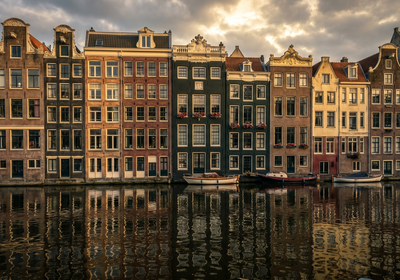


Major Highways (A-wegen): The Netherlands' dense highway network, including key routes like the A2 (Amsterdam-Maastricht), A4 (Amsterdam-The Hague), and A12 (The Hague-Arnhem), offers excellent and continuous 4G/5G coverage. Signal is particularly strong within the Randstad urban area, and complete dead zones are virtually nonexistent on major motorways.
NS Intercity Trains: Travel on the national rail system (NS) is well-covered. Major Intercity routes provide stable 4G and 5G signal, often supplemented by on-board Wi-Fi. You might notice slightly weaker performance on regional lines in the more rural eastern and northern provinces like Drenthe or Groningen, but extended signal loss is highly unusual.
Tunnels and Major Crossings: Most long road and rail tunnels, such as the Westerscheldetunnel in Zeeland or the network of tunnels around Rotterdam, are equipped with cellular repeaters, ensuring uninterrupted service. Signal is also consistently strong across major engineering works like the Afsluitdijk causeway.
Rural Provinces and National Parks: As an extremely flat country, the Netherlands has no mountains to disrupt signals. However, coverage can weaken in the center of large, protected nature areas like the Hoge Veluwe National Park or in very sparsely populated polders in Flevoland or Zeeland, though a complete loss of service is rare.
Wadden Islands (Waddeneilanden): While towns on the islands like Texel and Terschelling have reliable coverage, signal becomes less dependable in the vast dune landscapes and nature reserves away from populated centers. The ferry journey to the islands may also feature intermittent connectivity once far from the mainland shore.
How it works
Buy eSIM
Sign up and get your Global eSIM in just a few clicks.

Activate eSIM
Scan the QR code and get connected instantly — no physical SIM needed.

Pay as you go
Only pay for what you use. No contracts, no hidden fees.

Get your eSIM
“
I loved the per-country pricing model. I only paid for the countries I visited, and it was way cheaper than other eSIM providers. No hidden fees — just clear and simple.
“
The auto top-up feature is a lifesaver. I never have to check my balance — internet just works. And when I’m not traveling, I don’t pay. It’s fair and super convenient.


Angel Siphron
Rated
4.7


Bcengi TravelPass offers data at $1.19/GB when connected to KPN B.V. and Vodafone networks throughout the Netherlands. There are no daily charges, no required data bundles, and your balance does not expire.
No. TravelPass operates as an eSIM, functioning concurrently with your existing physical SIM card. Your primary SIM remains active for calls and texts, while TravelPass exclusively manages data services.
Yes, assuming your device supports eSIM technology. Compatible models include iPhone XS and newer, Pixel 3 and newer, and Galaxy S20 and newer. Please consult the compatibility page for a comprehensive list.
Connectivity through KPN B.V. and Vodafone is practically country-wide. 4G LTE covers more than 99% of the population. In rural polders and certain highly remote agricultural zones, you might experience infrequent 3G fallback, but dead spots are exceptionally rare.
For a week with typical usage-patterns - including daily navigation, social media browsing, and occasional video streaming - consider budgeting for 3-6 GB. If you primarily use hotel WiFi in the evenings and are offline during museum visits, you could manage with 2-3 GB.
Yes. NS intercity lines linking Amsterdam, Rotterdam, Utrecht, The Hague, and Eindhoven provide robust 4G connectivity throughout the journey. NS typically lacks onboard WiFi on most domestic routes, making mobile data your primary means of staying connected while on the train.
Yes. TravelPass is active throughout Europe, including in Belgium and Germany. You will be billed according to the specific per-gigabyte rate for that nation, rather than the Netherlands rate of $1.19/GB. All usage remains pay-as-you-go, without daily subscriptions or fixed roaming charges.
In most cases, yes. The Noord/Zuidlijn (metro line 52) underground stations are equipped with internal antenna systems offering functional 4G signals. While coverage is not assured in every subterranean location, most stations feature workable connectivity.
Yes - KPN and Vodafone maintain sales outlets at Schiphol and in major city centers. Tourist SIMs usually range from €10-20 for 5-15 GB, valid for 7-30 days. If you plan to consume most of that data, a tourist SIM can be economically viable. However, for stays of 3 days or fewer, or if combining your trip with other countries, TravelPass at $1.19/GB is generally more affordable overall.
No - the OV-chipkaart is a physical RFID card that functions independently of a data connection. However, data will be beneficial for using the 9292 app to plan routes, check real-time departures, and navigate transfers. The NS app also needs data to facilitate ticket purchases and provide live platform information.

$
1.19
/GB

Instant delivery

No expiry

24/7 support

Secure checkout

Pay As You Go
from
$
1.19
/GB
$10
POPULAR
$25
$50
$100
Select your starting balance
Get your eSIM
→

Secure Payments |
Powered by

Rated
4.7


💵 You add
$25
to your balance.
✈️ In
Netherlands
you use
3GB
at
$
1.19
/GB
.
🌍
Indonesia
3 months later -
3GB at $
1.81
/GB.
🔥 Your same balance covers both trips — one eSIM, no expiry, no wasted data, no new package.
How it works


Install once, keep it on your phone

Use balance only when you travel

Pay as you go, for actual use.

No fixed plans, no expiration

One eSIM for all trips, 200+ Countries.
Learn more
Just $
1.19
per GB.
No surprises, No bundles, No expiry.

Light Usage •
200 MB/day
$
0.00
/day
Maps, messaging, browsing

Moderate •
500 MB/day
$
0.00
/day

Heavy •
2 GB/day
$
0.00
/day
Streaming, uploads, video calls
Amsterdam: Excellent 4G and 5G coverage is available throughout the city center, canal belt, and major tourist districts. Connectivity on the Amsterdam Metro (GVB) is generally reliable on platforms and often between stations, especially on newer lines. Indoor signal can sometimes be weaker inside older, historic canal houses with thick stone walls.
Rotterdam: As a modern city, Rotterdam boasts superb 4G and 5G signal strength across its urban core and port area. The RET metro system, which runs both above and below ground, provides consistent connectivity at stations and on most overground sections, with good coverage in the underground tunnels as well.
The Hague: Expect strong and reliable mobile coverage across the city, from the government buildings at the Binnenhof to the Scheveningen beachfront. The local public transport system is mainly composed of above-ground trams (HTM), ensuring uninterrupted service while travelling.
Utrecht: Centrally located and densely populated, Utrecht offers fantastic 4G and 5G connectivity. Signal is strong around the busy Utrecht Centraal station and the historic city center. A unique local quirk is that coverage may be spotty inside the low-lying 'werfkelders' (wharf cellars) that have been converted into restaurants and bars along the canals.
Eindhoven: Known as a major technology hub, Eindhoven has top-tier mobile infrastructure with extensive 5G coverage. Connectivity is especially robust around the High Tech Campus and the redeveloped Strijp-S district. Indoor coverage in modern offices, university buildings, and event venues is excellent.
Major Highways (A-wegen): The Netherlands' dense highway network, including key routes like the A2 (Amsterdam-Maastricht), A4 (Amsterdam-The Hague), and A12 (The Hague-Arnhem), offers excellent and continuous 4G/5G coverage. Signal is particularly strong within the Randstad urban area, and complete dead zones are virtually nonexistent on major motorways.
NS Intercity Trains: Travel on the national rail system (NS) is well-covered. Major Intercity routes provide stable 4G and 5G signal, often supplemented by on-board Wi-Fi. You might notice slightly weaker performance on regional lines in the more rural eastern and northern provinces like Drenthe or Groningen, but extended signal loss is highly unusual.
Tunnels and Major Crossings: Most long road and rail tunnels, such as the Westerscheldetunnel in Zeeland or the network of tunnels around Rotterdam, are equipped with cellular repeaters, ensuring uninterrupted service. Signal is also consistently strong across major engineering works like the Afsluitdijk causeway.
Rural Provinces and National Parks: As an extremely flat country, the Netherlands has no mountains to disrupt signals. However, coverage can weaken in the center of large, protected nature areas like the Hoge Veluwe National Park or in very sparsely populated polders in Flevoland or Zeeland, though a complete loss of service is rare.
Wadden Islands (Waddeneilanden): While towns on the islands like Texel and Terschelling have reliable coverage, signal becomes less dependable in the vast dune landscapes and nature reserves away from populated centers. The ferry journey to the islands may also feature intermittent connectivity once far from the mainland shore.
Learn more about
Netherlands
How it works

1. Buy eSIM
Sign up and get your Global eSIM in just a few clicks.

2. Activate eSIM
Scan the QR code and get connected instantly — no physical SIM needed.

3. Pay as you go
Only pay for what you use. No contracts, no hidden fees.
Get your eSIM
Rated
4.7
“
I loved the per-country pricing model. I only paid for the countries I visited, and it was way cheaper than other eSIM providers. No hidden fees — just clear and simple.


Kaylynn Mango


Bcengi TravelPass offers data at $1.19/GB when connected to KPN B.V. and Vodafone networks throughout the Netherlands. There are no daily charges, no required data bundles, and your balance does not expire.
No. TravelPass operates as an eSIM, functioning concurrently with your existing physical SIM card. Your primary SIM remains active for calls and texts, while TravelPass exclusively manages data services.
Yes, assuming your device supports eSIM technology. Compatible models include iPhone XS and newer, Pixel 3 and newer, and Galaxy S20 and newer. Please consult the compatibility page for a comprehensive list.
Connectivity through KPN B.V. and Vodafone is practically country-wide. 4G LTE covers more than 99% of the population. In rural polders and certain highly remote agricultural zones, you might experience infrequent 3G fallback, but dead spots are exceptionally rare.
For a week with typical usage-patterns - including daily navigation, social media browsing, and occasional video streaming - consider budgeting for 3-6 GB. If you primarily use hotel WiFi in the evenings and are offline during museum visits, you could manage with 2-3 GB.
Yes. NS intercity lines linking Amsterdam, Rotterdam, Utrecht, The Hague, and Eindhoven provide robust 4G connectivity throughout the journey. NS typically lacks onboard WiFi on most domestic routes, making mobile data your primary means of staying connected while on the train.
Yes. TravelPass is active throughout Europe, including in Belgium and Germany. You will be billed according to the specific per-gigabyte rate for that nation, rather than the Netherlands rate of $1.19/GB. All usage remains pay-as-you-go, without daily subscriptions or fixed roaming charges.
In most cases, yes. The Noord/Zuidlijn (metro line 52) underground stations are equipped with internal antenna systems offering functional 4G signals. While coverage is not assured in every subterranean location, most stations feature workable connectivity.
Yes - KPN and Vodafone maintain sales outlets at Schiphol and in major city centers. Tourist SIMs usually range from €10-20 for 5-15 GB, valid for 7-30 days. If you plan to consume most of that data, a tourist SIM can be economically viable. However, for stays of 3 days or fewer, or if combining your trip with other countries, TravelPass at $1.19/GB is generally more affordable overall.
No - the OV-chipkaart is a physical RFID card that functions independently of a data connection. However, data will be beneficial for using the 9292 app to plan routes, check real-time departures, and navigate transfers. The NS app also needs data to facilitate ticket purchases and provide live platform information.
$
1.19
/GB
Instant delivery

No expiry
24/7 support
Secure checkout

Bcengi TravelPass keeps you connected worldwide with one reusable eSIM - no expirations, no wasted data.


Settings
English

USD


Bcengi TravelPass keeps you connected worldwide with one reusable eSIM - no expirations, no wasted data.



Secure Payments | Powered by