
Personal Travel
Personal Travel



Reunion

Orange reunion
Pay As You Go
from
$
1.19
/GB
$10
POPULAR
$25
$50
$100
Select your starting balance
Get your eSIM
→

Your payment is fully secured |
Powered by

Rated
4.7


Install once, keep it on your phone.

Pay as you go, for actual use.

No fixed plans, no expiration.

Use balance only when you travel.

One eSIM for all trips, 200+ Countries.
Pay As You Go data, wherever you travel
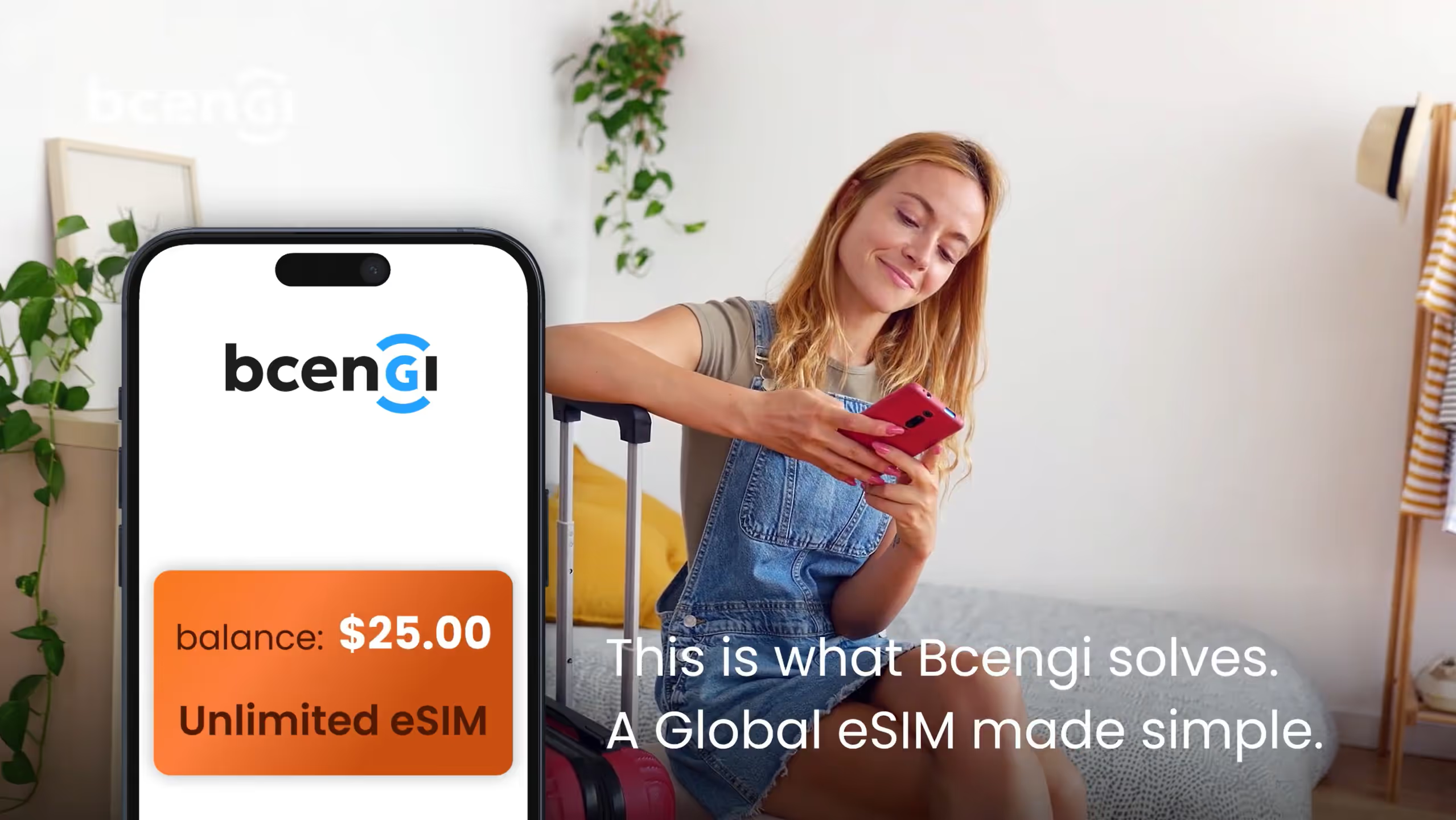
💵 You add
$25
to your balance.
✈️ In
Reunion
you use
3GB
at
$
1.19
/GB
.
🌍
France
3 months later -
3GB at $
1.19
/GB.
🔥 Your same balance covers both trips -
one eSIM, no expiry, no wasted data, no new package.
Just $
1.19
per GB. No surprises, No bundles, No expiry.

Light Usage
~200 MB/day
$
0.00
/day
Maps, messaging, browsing

Moderate
~500 MB/day
$
0.00
/day

Heavy
~2 GB/day
$
0.00
/day
Streaming, uploads, video calls
Saint-Denis: As the capital, you'll find strong 4G and expanding 5G coverage across the city, especially in the city center, along the Barachois waterfront, and near Roland Garros Airport. Indoor coverage in shops and restaurants is generally reliable. The island's bus network, Car Jaune, maintains a stable connection on routes within the urban core and along the main coastal highway.
Saint-Gilles les Bains: This primary resort area has excellent network performance along the popular western beaches and in the main tourist districts. Hotels, restaurants, and bars in L'Ermitage-les-Bains and Boucan Canot have strong 4G/5G signals. You might experience slightly weaker connectivity inside large, dense concrete hotel buildings or when traveling a short distance inland from the coast.
Saint-Pierre: The major city of the south offers robust and consistent 4G/5G connectivity. The bustling waterfront, main commercial streets, and market area are particularly well-covered, ensuring reliable service for navigation and data use throughout the city's urban zones.
Cilaos: The village center of Cilaos has dependable 4G coverage, making it easy to stay connected while in town. However, mobile signal becomes very intermittent and is often completely unavailable once you venture onto the hiking trails within the Cirque de Cilaos. Expect little to no service on remote mountain paths, such as the ascent to Piton des Neiges, and in deep ravines.



Coastal Ring Road (N1/N2): Coverage is generally reliable along the main coastal routes connecting Saint-Denis, Saint-Gilles, Saint-Paul, and Saint-Pierre. However, expect signal drops in tunnels along the Route des Tamarins (N1) and on the exposed Route du Littoral between Saint-Denis and La Possession, where service can be intermittent.
Trans-Island Route (N3): When traveling between Saint-Benoît and Saint-Pierre via the N3, also known as the Route de La Plaine, connectivity is inconsistent. Signal significantly weakens or disappears completely across the high plateaus of Plaine des Cafres and Plaine des Palmistes, which separate the island's two volcanic massifs.
The Cirques: Access roads into the volcanic calderas, such as the N5 to Cilaos and the D48 to Salazie, feature highly sporadic mobile signal due to the mountainous terrain and sharp turns. Within the cirques themselves, especially in remote areas and the pedestrian-only Cirque de Mafate, you should anticipate having no service at all.
Route du Volcan and the Wild South: The drive to the Piton de la Fournaise volcano via the Route Forestière 5 (RF5) involves long stretches with no cellular signal, particularly as you ascend into the barren Plaine des Sables. Similarly, the N2 road through the less-developed "Sud Sauvage" (Wild South) between Saint-Philippe and Saint-Joseph can have patchy coverage away from towns.
How it works
Buy eSIM
Sign up and get your Global eSIM in just a few clicks.

Activate eSIM
Scan the QR code and get connected instantly — no physical SIM needed.

Pay as you go
Only pay for what you use. No contracts, no hidden fees.

Get your eSIM
“
I loved the per-country pricing model. I only paid for the countries I visited, and it was way cheaper than other eSIM providers. No hidden fees — just clear and simple.
“
The auto top-up feature is a lifesaver. I never have to check my balance — internet just works. And when I’m not traveling, I don’t pay. It’s fair and super convenient.


Angel Siphron
Rated
4.7


Data with Bcengi costs $1.19 per gigabyte on the Orange Reunion networks. You pay only for the data you consume, with no mandatory bundles or minimum spending requirements.
No. Bcengi operates concurrently with your existing physical SIM card, leveraging dual-SIM technology. You can keep your regular SIM active for voice calls and text messages.
Yes, provided your specific device supports eSIM functionality (this typically includes most phone models manufactured from 2019 onwards). You can verify device compatibility at bcengi.com/travelpass/esim-compatibility.
Service availability depends on the Orange Reunion network infrastructure. Major urban centers and popular tourist zones generally experience robust coverage. However, isolated or remote regions might encounter reduced signal strength.
Most travelers typically use between 500 MB and 2 GB daily. A week of moderate usage would cost approximately $4.17 under the pay-as-you-go pricing structure.
Indeed. A single Bcengi eSIM is functional in over 200 nations. Your existing balance seamlessly transfers, eliminating the need to acquire a new eSIM for each subsequent destination.
You have the option to add funds at any moment by visiting travel.bcengi.com, or you can activate auto-refill to ensure your balance remains continuously active.
No. Your Bcengi balance maintains indefinite validity, whether you choose to use it next week or next year.

$
1.19
/GB

Instant delivery

No expiry

24/7 support

Secure checkout

Pay As You Go
from
$
1.19
/GB
$10
POPULAR
$25
$50
$100
Select your starting balance
Get your eSIM
→

Secure Payments |
Powered by

Rated
4.7


💵 You add
$25
to your balance.
✈️ In
Reunion
you use
3GB
at
$
1.19
/GB
.
🌍
France
3 months later -
3GB at $
1.19
/GB.
🔥 Your same balance covers both trips — one eSIM, no expiry, no wasted data, no new package.
How it works


Install once, keep it on your phone

Use balance only when you travel

Pay as you go, for actual use.

No fixed plans, no expiration

One eSIM for all trips, 200+ Countries.
Learn more
Just $
1.19
per GB.
No surprises, No bundles, No expiry.

Light Usage •
200 MB/day
$
0.00
/day
Maps, messaging, browsing

Moderate •
500 MB/day
$
0.00
/day

Heavy •
2 GB/day
$
0.00
/day
Streaming, uploads, video calls
Saint-Denis: As the capital, you'll find strong 4G and expanding 5G coverage across the city, especially in the city center, along the Barachois waterfront, and near Roland Garros Airport. Indoor coverage in shops and restaurants is generally reliable. The island's bus network, Car Jaune, maintains a stable connection on routes within the urban core and along the main coastal highway.
Saint-Gilles les Bains: This primary resort area has excellent network performance along the popular western beaches and in the main tourist districts. Hotels, restaurants, and bars in L'Ermitage-les-Bains and Boucan Canot have strong 4G/5G signals. You might experience slightly weaker connectivity inside large, dense concrete hotel buildings or when traveling a short distance inland from the coast.
Saint-Pierre: The major city of the south offers robust and consistent 4G/5G connectivity. The bustling waterfront, main commercial streets, and market area are particularly well-covered, ensuring reliable service for navigation and data use throughout the city's urban zones.
Cilaos: The village center of Cilaos has dependable 4G coverage, making it easy to stay connected while in town. However, mobile signal becomes very intermittent and is often completely unavailable once you venture onto the hiking trails within the Cirque de Cilaos. Expect little to no service on remote mountain paths, such as the ascent to Piton des Neiges, and in deep ravines.
Coastal Ring Road (N1/N2): Coverage is generally reliable along the main coastal routes connecting Saint-Denis, Saint-Gilles, Saint-Paul, and Saint-Pierre. However, expect signal drops in tunnels along the Route des Tamarins (N1) and on the exposed Route du Littoral between Saint-Denis and La Possession, where service can be intermittent.
Trans-Island Route (N3): When traveling between Saint-Benoît and Saint-Pierre via the N3, also known as the Route de La Plaine, connectivity is inconsistent. Signal significantly weakens or disappears completely across the high plateaus of Plaine des Cafres and Plaine des Palmistes, which separate the island's two volcanic massifs.
The Cirques: Access roads into the volcanic calderas, such as the N5 to Cilaos and the D48 to Salazie, feature highly sporadic mobile signal due to the mountainous terrain and sharp turns. Within the cirques themselves, especially in remote areas and the pedestrian-only Cirque de Mafate, you should anticipate having no service at all.
Route du Volcan and the Wild South: The drive to the Piton de la Fournaise volcano via the Route Forestière 5 (RF5) involves long stretches with no cellular signal, particularly as you ascend into the barren Plaine des Sables. Similarly, the N2 road through the less-developed "Sud Sauvage" (Wild South) between Saint-Philippe and Saint-Joseph can have patchy coverage away from towns.
Learn more about
Reunion
How it works

1. Buy eSIM
Sign up and get your Global eSIM in just a few clicks.

2. Activate eSIM
Scan the QR code and get connected instantly — no physical SIM needed.

3. Pay as you go
Only pay for what you use. No contracts, no hidden fees.
Get your eSIM
Rated
4.7
“
I loved the per-country pricing model. I only paid for the countries I visited, and it was way cheaper than other eSIM providers. No hidden fees — just clear and simple.


Kaylynn Mango


Data with Bcengi costs $1.19 per gigabyte on the Orange Reunion networks. You pay only for the data you consume, with no mandatory bundles or minimum spending requirements.
No. Bcengi operates concurrently with your existing physical SIM card, leveraging dual-SIM technology. You can keep your regular SIM active for voice calls and text messages.
Yes, provided your specific device supports eSIM functionality (this typically includes most phone models manufactured from 2019 onwards). You can verify device compatibility at bcengi.com/travelpass/esim-compatibility.
Service availability depends on the Orange Reunion network infrastructure. Major urban centers and popular tourist zones generally experience robust coverage. However, isolated or remote regions might encounter reduced signal strength.
Most travelers typically use between 500 MB and 2 GB daily. A week of moderate usage would cost approximately $4.17 under the pay-as-you-go pricing structure.
Indeed. A single Bcengi eSIM is functional in over 200 nations. Your existing balance seamlessly transfers, eliminating the need to acquire a new eSIM for each subsequent destination.
You have the option to add funds at any moment by visiting travel.bcengi.com, or you can activate auto-refill to ensure your balance remains continuously active.
No. Your Bcengi balance maintains indefinite validity, whether you choose to use it next week or next year.
$
1.19
/GB
Instant delivery

No expiry
24/7 support
Secure checkout

Bcengi TravelPass keeps you connected worldwide with one reusable eSIM - no expirations, no wasted data.


Settings
English

USD


Bcengi TravelPass keeps you connected worldwide with one reusable eSIM - no expirations, no wasted data.



Secure Payments | Powered by