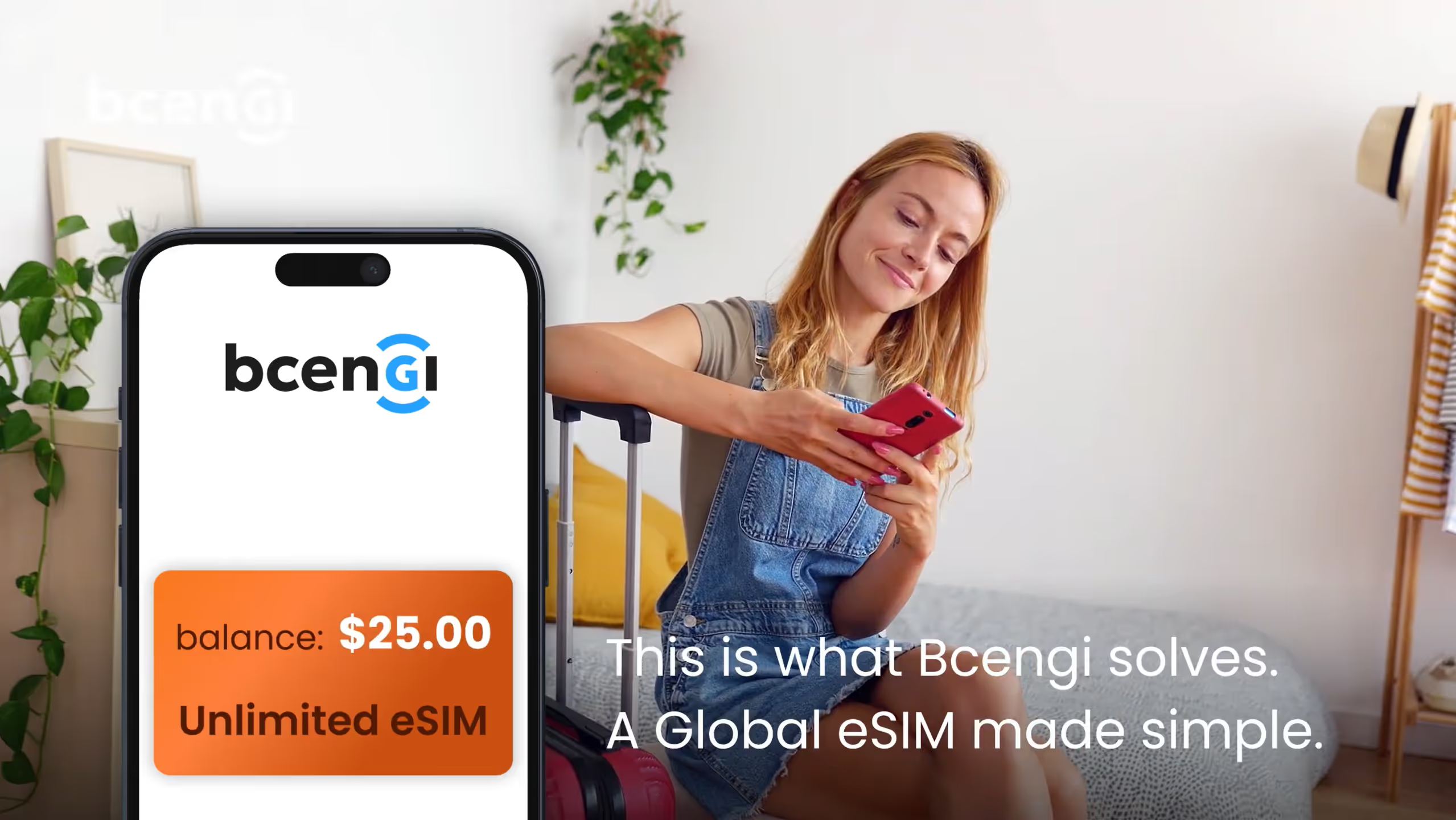

Personal Travel
Personal Travel



Cruise Ship (email support to enable)

Wireless Maritime Services
Pay As You Go
from
$
52.96
/GB
$10
POPULAR
$25
$50
$100
Select your starting balance
Get your eSIM
→

Your payment is fully secured |
Powered by

Rated
4.7


Install once, keep it on your phone.

Pay as you go, for actual use.

No fixed plans, no expiration.

Use balance only when you travel.

One eSIM for all trips, 200+ Countries.
Pay As You Go data, wherever you travel
💵 You add
$25
to your balance.
✈️ In
Cruise Ship (email support to enable)
you use
3GB
at
$
52.96
/GB
.
🌍
United States
3 months later -
3GB at $
1.68
/GB.
🔥 Your same balance covers both trips -
one eSIM, no expiry, no wasted data, no new package.
Just $
52.96
per GB. No surprises, No bundles, No expiry.

Light Usage
~200 MB/day
$
0.00
/day
Maps, messaging, browsing

Moderate
~500 MB/day
$
0.00
/day

Heavy
~2 GB/day
$
0.00
/day
Streaming, uploads, video calls
Barcelona: Major Spanish networks provide excellent 4G and 5G coverage across the city, especially in tourist-heavy areas like the Gothic Quarter and around Port Vell. The Barcelona Metro system offers reliable signal on most platforms and within many tunnels, though older lines can have brief gaps. Indoor reception is strong, but can be weaker inside the thick stone walls of historic buildings.
Nassau: Reliable 4G LTE coverage is available throughout downtown Nassau, the cruise port, and across on Paradise Island. Service is generally strong in the main tourist shopping areas and resorts. Indoor signal can be inconsistent inside large hotel complexes or crowded markets. Be aware that service may be limited or unavailable on smaller, private islands visited during excursions.
Cozumel: You'll find strong 4G LTE service from local carriers in the main town of San Miguel and around the international cruise terminals. Coverage is reliable at the major beach clubs and resorts along the western coast. Signal strength can decrease significantly inside concrete buildings or if you travel to the less-developed eastern side of the island.
Singapore: As one of the world's most connected cities, Singapore offers exceptional 4G and 5G coverage virtually everywhere. Signal is strong across all tourist districts, from Marina Bay to Sentosa Island. The MRT subway system provides seamless, high-speed connectivity in both stations and while travelling in underground tunnels, setting a global standard for transit coverage.
Civitavecchia (Rome): The port of Civitavecchia has good connectivity. For day trips to Rome, you will find excellent 4G and 5G coverage throughout the city's core tourist areas. The Rome Metro (Metropolitana) has consistent signal on platforms, but connections frequently drop between stations on the deeper, older lines. Signal on the train between the port and Rome is generally stable.


Major Expressways: Coverage is strong along key arteries like the Tōmei (E1), Chūō (E20), and San'yō (E2) expressways, especially near metropolitan areas. However, expect intermittent signal drops in mountainous sections, such as when the Chūō Expressway crosses the Japanese Alps between Tokyo and Nagoya.
Shinkansen (Bullet Train): Connectivity is generally reliable on major Shinkansen lines like the Tōkaidō line (Tokyo-Osaka), but most carriers lose signal completely inside the numerous long tunnels. This is particularly noticeable on the Hokuriku and Jōetsu lines through the mountains, and for the entire duration of the Seikan Tunnel to Hokkaido.
Mountainous Regions: The interior of Japan is dominated by mountains. Vast areas within the Japanese Alps, the Kii Peninsula, and the central mountains of Shikoku and Hokkaido have limited or no cellular service, impacting connectivity on smaller national roads and scenic driving routes away from expressways.
Long Tunnels: Japan's mountainous terrain necessitates many long road tunnels where mobile signal is unavailable. Expect service to drop completely in major tunnels like the Kan-Etsu Tunnel (E17) and the Hida Tunnel (E41), with signal resuming upon exit.
Remote Islands and Coastlines: While Japan's main islands are well-covered, signal strength can be poor or non-existent on less populated outer islands, such as those in the Ogasawara or Yaeyama chains. Similarly, remote coastal areas, particularly along the Sea of Japan in northern Honshu, may experience weaker coverage between towns.
How it works
Buy eSIM
Sign up and get your Global eSIM in just a few clicks.

Activate eSIM
Scan the QR code and get connected instantly — no physical SIM needed.

Pay as you go
Only pay for what you use. No contracts, no hidden fees.

Get your eSIM
“
I loved the per-country pricing model. I only paid for the countries I visited, and it was way cheaper than other eSIM providers. No hidden fees — just clear and simple.
“
The auto top-up feature is a lifesaver. I never have to check my balance — internet just works. And when I’m not traveling, I don’t pay. It’s fair and super convenient.


Angel Siphron
Rated
4.7


To enable cruise connectivity, please send an email to support@bcengi.com from the address associated with your Bcengi account. We will then activate it on your eSIM. This is a one-time configuration, meaning it will remain active for all your subsequent voyages.
Data consumption at sea is substantially more costly compared to land-based roaming. We prefer you consciously choose to activate this service rather than encountering unexpected charges.
The cost for cruise data is $52.96 per gigabyte. You are billed solely for the data you consume, with no requirement for bundles or minimum spending.
Our service functions with over 25 major cruise operators, including Royal Caribbean, Carnival, MSC, Norwegian, Disney, Princess, and Holland America. The complete list can be found earlier on this page.
When your ship is in port, your eSIM will connect to local land networks at the destination, and standard country rates will apply.
Yes, a decrease in pricing is expected. eSIM coverage for cruises is a relatively new offering in the industry. As more mobile carriers and ships adopt this technology, a reduction in costs is anticipated.

$
52.96
/GB

Instant delivery

No expiry

24/7 support

Secure checkout

Pay As You Go
from
$
52.96
/GB
$10
POPULAR
$25
$50
$100
Select your starting balance
Get your eSIM
→

Secure Payments |
Powered by

Rated
4.7


💵 You add
$25
to your balance.
✈️ In
Cruise Ship (email support to enable)
you use
3GB
at
$
52.96
/GB
.
🌍
United States
3 months later -
3GB at $
1.68
/GB.
🔥 Your same balance covers both trips — one eSIM, no expiry, no wasted data, no new package.
How it works


Install once, keep it on your phone

Use balance only when you travel

Pay as you go, for actual use.

No fixed plans, no expiration

One eSIM for all trips, 200+ Countries.
Learn more
Just $
52.96
per GB.
No surprises, No bundles, No expiry.

Light Usage •
200 MB/day
$
0.00
/day
Maps, messaging, browsing

Moderate •
500 MB/day
$
0.00
/day

Heavy •
2 GB/day
$
0.00
/day
Streaming, uploads, video calls
Barcelona: Major Spanish networks provide excellent 4G and 5G coverage across the city, especially in tourist-heavy areas like the Gothic Quarter and around Port Vell. The Barcelona Metro system offers reliable signal on most platforms and within many tunnels, though older lines can have brief gaps. Indoor reception is strong, but can be weaker inside the thick stone walls of historic buildings.
Nassau: Reliable 4G LTE coverage is available throughout downtown Nassau, the cruise port, and across on Paradise Island. Service is generally strong in the main tourist shopping areas and resorts. Indoor signal can be inconsistent inside large hotel complexes or crowded markets. Be aware that service may be limited or unavailable on smaller, private islands visited during excursions.
Cozumel: You'll find strong 4G LTE service from local carriers in the main town of San Miguel and around the international cruise terminals. Coverage is reliable at the major beach clubs and resorts along the western coast. Signal strength can decrease significantly inside concrete buildings or if you travel to the less-developed eastern side of the island.
Singapore: As one of the world's most connected cities, Singapore offers exceptional 4G and 5G coverage virtually everywhere. Signal is strong across all tourist districts, from Marina Bay to Sentosa Island. The MRT subway system provides seamless, high-speed connectivity in both stations and while travelling in underground tunnels, setting a global standard for transit coverage.
Civitavecchia (Rome): The port of Civitavecchia has good connectivity. For day trips to Rome, you will find excellent 4G and 5G coverage throughout the city's core tourist areas. The Rome Metro (Metropolitana) has consistent signal on platforms, but connections frequently drop between stations on the deeper, older lines. Signal on the train between the port and Rome is generally stable.
Major Expressways: Coverage is strong along key arteries like the Tōmei (E1), Chūō (E20), and San'yō (E2) expressways, especially near metropolitan areas. However, expect intermittent signal drops in mountainous sections, such as when the Chūō Expressway crosses the Japanese Alps between Tokyo and Nagoya.
Shinkansen (Bullet Train): Connectivity is generally reliable on major Shinkansen lines like the Tōkaidō line (Tokyo-Osaka), but most carriers lose signal completely inside the numerous long tunnels. This is particularly noticeable on the Hokuriku and Jōetsu lines through the mountains, and for the entire duration of the Seikan Tunnel to Hokkaido.
Mountainous Regions: The interior of Japan is dominated by mountains. Vast areas within the Japanese Alps, the Kii Peninsula, and the central mountains of Shikoku and Hokkaido have limited or no cellular service, impacting connectivity on smaller national roads and scenic driving routes away from expressways.
Long Tunnels: Japan's mountainous terrain necessitates many long road tunnels where mobile signal is unavailable. Expect service to drop completely in major tunnels like the Kan-Etsu Tunnel (E17) and the Hida Tunnel (E41), with signal resuming upon exit.
Remote Islands and Coastlines: While Japan's main islands are well-covered, signal strength can be poor or non-existent on less populated outer islands, such as those in the Ogasawara or Yaeyama chains. Similarly, remote coastal areas, particularly along the Sea of Japan in northern Honshu, may experience weaker coverage between towns.
Learn more about
Cruise Ship (email support to enable)
How it works

1. Buy eSIM
Sign up and get your Global eSIM in just a few clicks.

2. Activate eSIM
Scan the QR code and get connected instantly — no physical SIM needed.

3. Pay as you go
Only pay for what you use. No contracts, no hidden fees.
Get your eSIM
Rated
4.7
“
I loved the per-country pricing model. I only paid for the countries I visited, and it was way cheaper than other eSIM providers. No hidden fees — just clear and simple.


Kaylynn Mango


To enable cruise connectivity, please send an email to support@bcengi.com from the address associated with your Bcengi account. We will then activate it on your eSIM. This is a one-time configuration, meaning it will remain active for all your subsequent voyages.
Data consumption at sea is substantially more costly compared to land-based roaming. We prefer you consciously choose to activate this service rather than encountering unexpected charges.
The cost for cruise data is $52.96 per gigabyte. You are billed solely for the data you consume, with no requirement for bundles or minimum spending.
Our service functions with over 25 major cruise operators, including Royal Caribbean, Carnival, MSC, Norwegian, Disney, Princess, and Holland America. The complete list can be found earlier on this page.
When your ship is in port, your eSIM will connect to local land networks at the destination, and standard country rates will apply.
Yes, a decrease in pricing is expected. eSIM coverage for cruises is a relatively new offering in the industry. As more mobile carriers and ships adopt this technology, a reduction in costs is anticipated.
$
52.96
/GB
Instant delivery

No expiry
24/7 support
Secure checkout

Bcengi TravelPass keeps you connected worldwide with one reusable eSIM - no expirations, no wasted data.


Settings
English

USD


Bcengi TravelPass keeps you connected worldwide with one reusable eSIM - no expirations, no wasted data.



Secure Payments | Powered by