
Personal Travel
Personal Travel



Vatican City

Iliad Italy, TIM, Wind Telecomunicazioni SpA
Pay As You Go
from
$
1.19
/GB
$10
POPULAR
$25
$50
$100
Select your starting balance
Get your eSIM
→

Your payment is fully secured |
Powered by

Rated
4.7


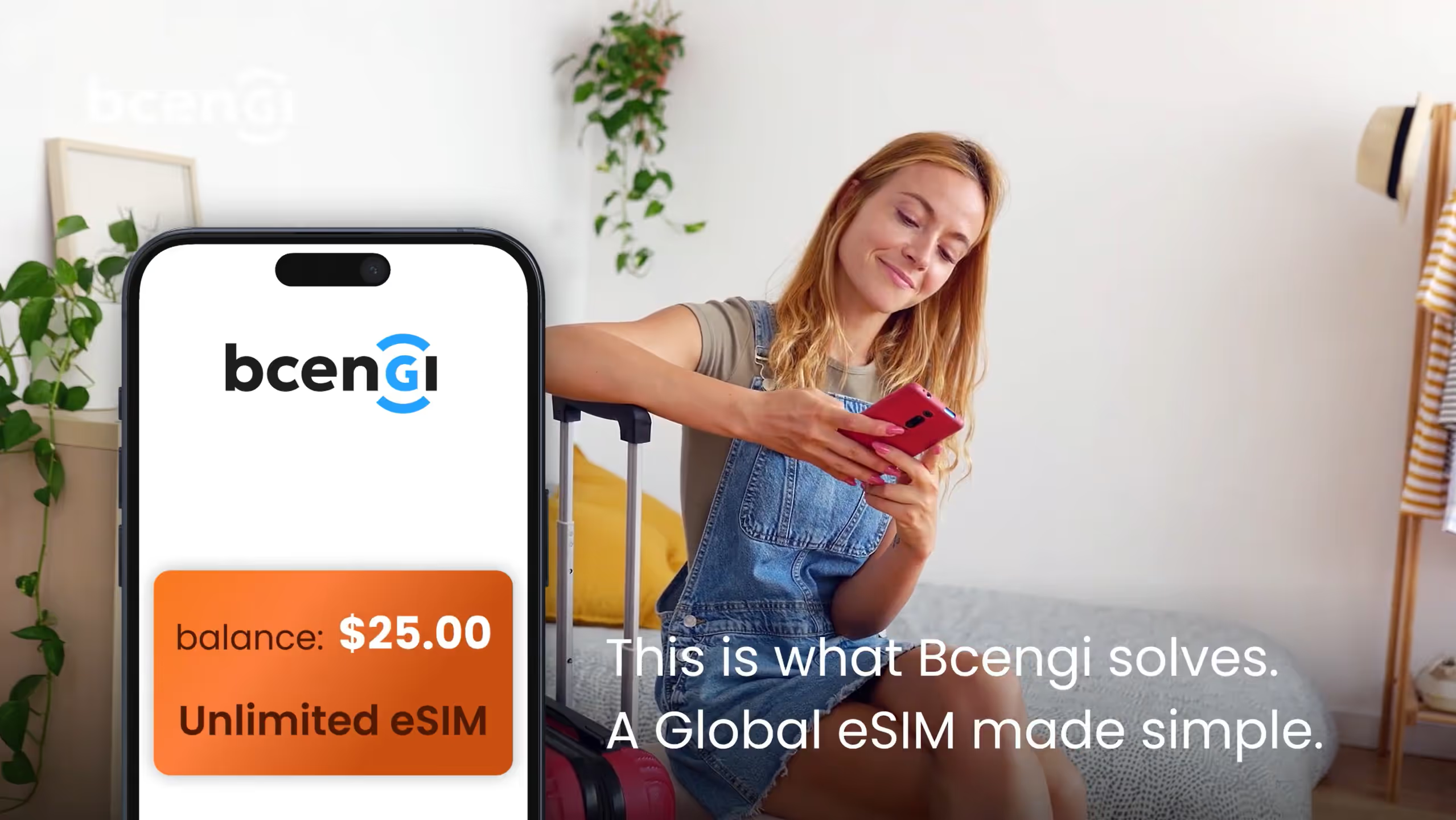
Install once, keep it on your phone.

Pay as you go, for actual use.

No fixed plans, no expiration.

Use balance only when you travel.

One eSIM for all trips, 200+ Countries.
Pay As You Go data, wherever you travel
💵 You add
$25
to your balance.
✈️ In
Vatican City
you use
3GB
at
$
1.19
/GB
.
🌍
United States
3 months later -
3GB at $
1.68
/GB.
🔥 Your same balance covers both trips -
one eSIM, no expiry, no wasted data, no new package.
Just $
1.19
per GB. No surprises, No bundles, No expiry.

Light Usage
~200 MB/day
$
0.00
/day
Maps, messaging, browsing

Moderate
~500 MB/day
$
0.00
/day

Heavy
~2 GB/day
$
0.00
/day
Streaming, uploads, video calls
Vatican City: As a microstate located entirely within Rome, Vatican City is fully served by major Italian mobile networks like TIM, Vodafone, and WindTre, offering excellent 4G and 5G coverage throughout its territory. The primary challenge is not a lack of signal but network congestion due to the immense number of daily visitors.
St. Peter's Square: In this large, open-air plaza, mobile signal is consistently strong. However, during major events like a Papal address, Easter Mass, or on Wednesdays, the cellular networks can become overloaded, leading to significantly slower data speeds and difficulty in placing calls.
St. Peter's Basilica: Due to the basilica's immense size and thick marble and stone construction, indoor coverage is highly variable. You will find a strong signal near the main entrance, but it weakens considerably as you move deeper inside. Expect poor to non-existent connectivity in the underground grottoes or during the ascent to the top of the dome.
Vatican Museums: Connectivity across the sprawling museum complex is inconsistent. Signal is generally good in open areas like the Pinecone Courtyard or in galleries with large windows, but it degrades sharply in interior halls. In the Sistine Chapel, reception is notoriously poor due to the solid, windowless structure designed to protect the frescoes.
Vatican Gardens: Mobile coverage throughout the majority of the expansive gardens is excellent, providing reliable service for navigation and data use. In a few densely wooded or lower-lying sections, the signal might be slightly weaker, but for the most part, you can expect a strong and stable connection.



Italian Autostrade: Connectivity is excellent when leaving the Vatican City area via Rome's primary ring road, the A90 (Grande Raccordo Anulare), and on major connecting motorways like the A1 Autostrada. Signal remains strong along these key corridors, but can become less reliable on smaller state roads (Strade Statali) that venture into the rural countryside of the Lazio region.
Trenitalia Rail Network: High-speed Frecciarossa and Intercity trains departing from Rome's Termini and Tiburtina stations offer generally stable connectivity. However, expect frequent signal interruptions and complete loss of service inside the numerous long tunnels, particularly on the high-speed routes heading north towards Florence and south towards Naples.
Rome Metro (Metropolitana): While not intercity travel, reaching Italy's national rail and bus hubs from the Vatican often involves the Rome Metro. Cellular service is typically available on station platforms but is completely lost in the underground tunnels between stops. Plan for offline access to maps and tickets during these segments.
Central Apennine Region: As you travel east from Rome towards the Apennine Mountains, for example on the A24 motorway, mobile coverage becomes noticeably intermittent. The mountainous terrain, deep valleys, and less populated areas create frequent dead zones where signal can be weak or entirely absent for several kilometers.
How it works
Buy eSIM
Sign up and get your Global eSIM in just a few clicks.

Activate eSIM
Scan the QR code and get connected instantly — no physical SIM needed.

Pay as you go
Only pay for what you use. No contracts, no hidden fees.

Get your eSIM
“
I loved the per-country pricing model. I only paid for the countries I visited, and it was way cheaper than other eSIM providers. No hidden fees — just clear and simple.
“
The auto top-up feature is a lifesaver. I never have to check my balance — internet just works. And when I’m not traveling, I don’t pay. It’s fair and super convenient.


Angel Siphron
Rated
4.7


Bcengi provides data at $1.19 per gigabyte across the TIM, Wind Telecomunicazioni SpA, and vodafone networks. Users are billed solely for the data consumed, with no requirement for bundles or minimum expenditures.
It is not. Bcengi operates concurrently with your current SIM through dual-SIM capabilities. Your traditional SIM can remain active for making calls and sending messages.
Yes, provided your specific device supports eSIM functionality (which includes the majority of phones manufactured from 2019 onwards). You can verify device compatibility by visiting bcengi.com/travelpass/esim-compatibility.
Service availability is contingent on the network infrastructure of TIM, Wind Telecomunicazioni SpA, and vodafone. While significant urban centers and popular tourist spots generally benefit from robust coverage, signal strength might be restricted in less accessible regions.
Typically, visitors consume between 500 MB and 2 GB of data daily. A week of average usage could cost around $4.17 when utilizing the pay-as-you-go pricing model.
Indeed. A single Bcengi eSIM is operational across more than 200 nations. Your remaining balance transfers, eliminating the requirement to purchase a separate eSIM for every new location.
You have the option to add funds at any moment by visiting travel.bcengi.com, or you can activate an auto-refill feature to ensure your balance is continuously maintained.
No, your Bcengi balance remains valid indefinitely. It will not expire, whether you choose to use it in the near future or at a later point.

$
1.19
/GB

Instant delivery

No expiry

24/7 support

Secure checkout

Pay As You Go
from
$
1.19
/GB
$10
POPULAR
$25
$50
$100
Select your starting balance
Get your eSIM
→

Secure Payments |
Powered by

Rated
4.7


💵 You add
$25
to your balance.
✈️ In
Vatican City
you use
3GB
at
$
1.19
/GB
.
🌍
United States
3 months later -
3GB at $
1.68
/GB.
🔥 Your same balance covers both trips — one eSIM, no expiry, no wasted data, no new package.
How it works


Install once, keep it on your phone

Use balance only when you travel

Pay as you go, for actual use.

No fixed plans, no expiration

One eSIM for all trips, 200+ Countries.
Learn more
Just $
1.19
per GB.
No surprises, No bundles, No expiry.

Light Usage •
200 MB/day
$
0.00
/day
Maps, messaging, browsing

Moderate •
500 MB/day
$
0.00
/day

Heavy •
2 GB/day
$
0.00
/day
Streaming, uploads, video calls
Vatican City: As a microstate located entirely within Rome, Vatican City is fully served by major Italian mobile networks like TIM, Vodafone, and WindTre, offering excellent 4G and 5G coverage throughout its territory. The primary challenge is not a lack of signal but network congestion due to the immense number of daily visitors.
St. Peter's Square: In this large, open-air plaza, mobile signal is consistently strong. However, during major events like a Papal address, Easter Mass, or on Wednesdays, the cellular networks can become overloaded, leading to significantly slower data speeds and difficulty in placing calls.
St. Peter's Basilica: Due to the basilica's immense size and thick marble and stone construction, indoor coverage is highly variable. You will find a strong signal near the main entrance, but it weakens considerably as you move deeper inside. Expect poor to non-existent connectivity in the underground grottoes or during the ascent to the top of the dome.
Vatican Museums: Connectivity across the sprawling museum complex is inconsistent. Signal is generally good in open areas like the Pinecone Courtyard or in galleries with large windows, but it degrades sharply in interior halls. In the Sistine Chapel, reception is notoriously poor due to the solid, windowless structure designed to protect the frescoes.
Vatican Gardens: Mobile coverage throughout the majority of the expansive gardens is excellent, providing reliable service for navigation and data use. In a few densely wooded or lower-lying sections, the signal might be slightly weaker, but for the most part, you can expect a strong and stable connection.
Italian Autostrade: Connectivity is excellent when leaving the Vatican City area via Rome's primary ring road, the A90 (Grande Raccordo Anulare), and on major connecting motorways like the A1 Autostrada. Signal remains strong along these key corridors, but can become less reliable on smaller state roads (Strade Statali) that venture into the rural countryside of the Lazio region.
Trenitalia Rail Network: High-speed Frecciarossa and Intercity trains departing from Rome's Termini and Tiburtina stations offer generally stable connectivity. However, expect frequent signal interruptions and complete loss of service inside the numerous long tunnels, particularly on the high-speed routes heading north towards Florence and south towards Naples.
Rome Metro (Metropolitana): While not intercity travel, reaching Italy's national rail and bus hubs from the Vatican often involves the Rome Metro. Cellular service is typically available on station platforms but is completely lost in the underground tunnels between stops. Plan for offline access to maps and tickets during these segments.
Central Apennine Region: As you travel east from Rome towards the Apennine Mountains, for example on the A24 motorway, mobile coverage becomes noticeably intermittent. The mountainous terrain, deep valleys, and less populated areas create frequent dead zones where signal can be weak or entirely absent for several kilometers.
Learn more about
Vatican City
How it works

1. Buy eSIM
Sign up and get your Global eSIM in just a few clicks.

2. Activate eSIM
Scan the QR code and get connected instantly — no physical SIM needed.

3. Pay as you go
Only pay for what you use. No contracts, no hidden fees.
Get your eSIM
Rated
4.7
“
I loved the per-country pricing model. I only paid for the countries I visited, and it was way cheaper than other eSIM providers. No hidden fees — just clear and simple.


Kaylynn Mango


Bcengi provides data at $1.19 per gigabyte across the TIM, Wind Telecomunicazioni SpA, and vodafone networks. Users are billed solely for the data consumed, with no requirement for bundles or minimum expenditures.
It is not. Bcengi operates concurrently with your current SIM through dual-SIM capabilities. Your traditional SIM can remain active for making calls and sending messages.
Yes, provided your specific device supports eSIM functionality (which includes the majority of phones manufactured from 2019 onwards). You can verify device compatibility by visiting bcengi.com/travelpass/esim-compatibility.
Service availability is contingent on the network infrastructure of TIM, Wind Telecomunicazioni SpA, and vodafone. While significant urban centers and popular tourist spots generally benefit from robust coverage, signal strength might be restricted in less accessible regions.
Typically, visitors consume between 500 MB and 2 GB of data daily. A week of average usage could cost around $4.17 when utilizing the pay-as-you-go pricing model.
Indeed. A single Bcengi eSIM is operational across more than 200 nations. Your remaining balance transfers, eliminating the requirement to purchase a separate eSIM for every new location.
You have the option to add funds at any moment by visiting travel.bcengi.com, or you can activate an auto-refill feature to ensure your balance is continuously maintained.
No, your Bcengi balance remains valid indefinitely. It will not expire, whether you choose to use it in the near future or at a later point.
$
1.19
/GB
Instant delivery

No expiry
24/7 support
Secure checkout

Bcengi TravelPass keeps you connected worldwide with one reusable eSIM - no expirations, no wasted data.


Settings
English

USD


Bcengi TravelPass keeps you connected worldwide with one reusable eSIM - no expirations, no wasted data.



Secure Payments | Powered by